INTERACTIVE BATTLE
Battle of Itsukushima
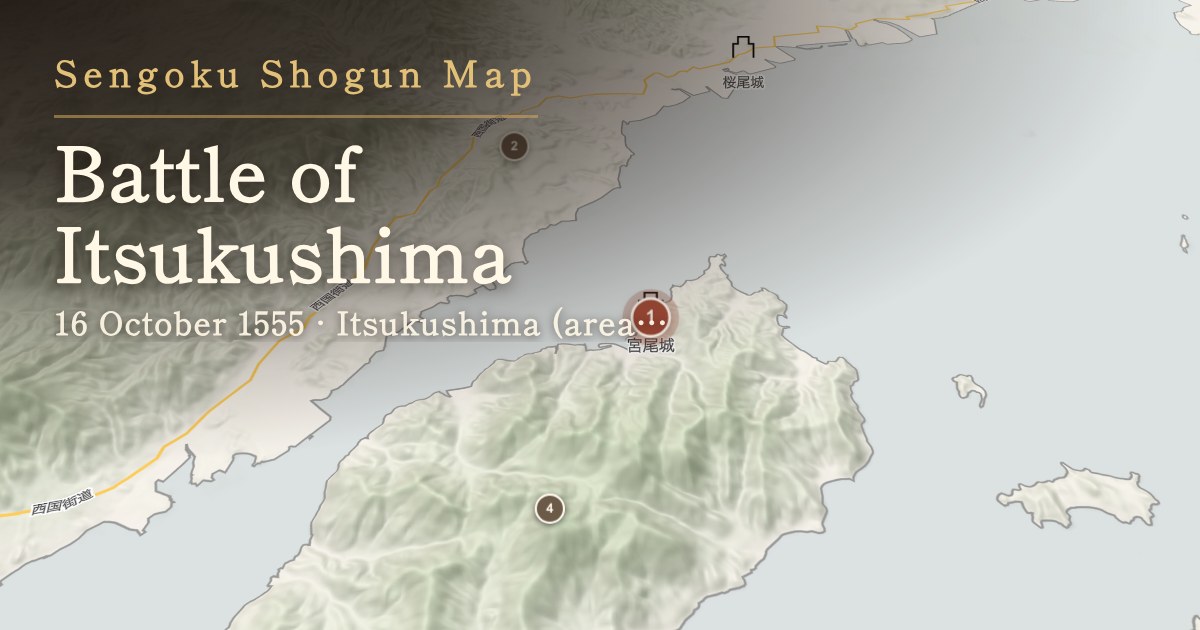
16 October 1555 · Itsukushima (area around Miyao Castle)
Mōri Motonari crossed to the island of Itsukushima and struck the camp on Tō-no-oka held by Sue Harukata, who by then wielded the real power of the Ōuchi house. The weaker side had chosen a narrow island as its ground.
Background
In the Taineiji Incident of 1551 Sue Harukata had driven Ōuchi Yoshitaka to take his own life. Mōri Motonari, who had been allied with Yoshitaka, turned his troops against him. To offset the difference in numbers, Motonari built Miyao Castle on the north of Miyajima and drew the Sue army onto the island.
Outcome
Harukata fled and took his own life, as did his general Hironaka Takakane. The Ōuchi could no longer hold Suō and Nagato, and from the next year the Mōri began their conquest of the two provinces.
Course of the battle
1 September 1555
The Sue army lands on Itsukushima and camps on Tō-no-oka
Sue Harukata's army landed on Miyajima. It camped first at Katsuyama, then moved its headquarters to Tō-no-oka, which looks down on Miyao Castle, and pressed the attack. The castle held.
Camps on Tō-no-oka
Sources14·Certainty: Medium
2 Before dawn, 16 October
Motonari crosses from Jigozen to Tsutsumigaura
3 Morning of 16 October
The Mōri charge down from Bakuchio onto the Sue camp
The Mōri came ashore at Tsutsumigaura, crossed the ridge of Bakuchio and charged down on the Sue camp at Tō-no-oka. The garrison of Miyao Castle sallied out at the same time, and the Sue found themselves caught between the two.
Points of debate
How far the garrison of Miyao Castle acted in concert, and how far the Murakami fleet took part in the crossing, are described differently from source to source.
Charges down from Bakuchio
Rides with the main body
Sources123·Certainty: Medium
4 16 October
Sue Harukata flees and takes his own life
The Sue army broke and fled. Hironaka Takakane took his own life after the rout, and Harukata did the same on the island.
Flees, then takes his own life
Flees, then takes his own life
Sources123·Certainty: High
Historical significance
The battle marks the point at which the Mōri, until then a local house in Aki, became a major power in the Chūgoku region. The route of the crossing, the landing place and the numbers engaged are all still debated.
Key figures
毛利氏
4

Commander of the Mōri army
Led the main body that crossed from Jigozen to Tsutsumigaura and struck the Sue camp from Bakuchio.
Sources1·Certainty: Medium
Head of the main Mōri house
As Motonari's heir he had already succeeded to the main house, and is said to have ridden with the main body.
Sources1·Certainty: Medium

Commanded the Mōri fleet
Having succeeded to the Kobayakawa house, he is said to have handled the ships of the Inland Sea that made the crossing possible.
Sources1·Certainty: Medium
Mōri general
He had succeeded to the Kikkawa house and held the San'in side. At Itsukushima he is said to have ridden with the main body.
Sources1·Certainty: Medium
大内氏
2

Commander of the Ōuchi army
Landed on Miyajima, camped on Tō-no-oka and attacked Miyao Castle. He took his own life after the rout.
Sources1·Certainty: High
Ōuchi general
He fought on the island for the Sue side; the Miyajima Tourist Association records that he took his own life after the rout.
Sources1·Certainty: Medium
Other events of 1555
Notes on the data
Dates are given in the Western (Julian) calendar. The sources use the lunar calendar; 16 October corresponds to the first day of the tenth month of Kōji 1. Troop numbers rest on tradition and are left out of the text. Points on the map are approximate positions of historic and traditional sites, not the limits of the battlefield.
Sources consulted
- 宮島観光協会「厳島合戦」
- 広島県「戦国大名とひろしま~毛利元就~」
- 廿日市市「宮島物知り図鑑:宮島ゆかりの人々」
- 城郭マスタ(shiro.geojson)
- 宮島観光協会「宮島の歴史」
- 地理院地図 住所検索(広島県廿日市市地御前)
The numbers in the text refer to the list above. Certainty indicates how far a statement is supported by the cited sources; it does not refer to the precision of the coordinates or the dating.
Advertisement