INTERACTIVE BATTLE
Battle of the Nagara River
28 May 1556 · Nagaragawa, the Nagara River in Mino Province (now Gifu)
Saitō Dōsan, who had retired from the lordship of Mino, and his heir Yoshitatsu, who had succeeded him, fought on the Nagara River, and Dōsan was killed. The relief force of his son-in-law Oda Nobunaga did not arrive in time.
Background
Dōsan handed the headship to Yoshitatsu in 1554 and retired to Sagiyama Castle. He favoured Yoshitatsu's younger brothers, the two men fell out, and in 1555 Yoshitatsu killed the brothers, making the break final.
Outcome
Dōsan was killed and Yoshitatsu took Mino in hand. Nobunaga fell back to Owari under pursuit, and for the next ten years he would be attacking Mino.
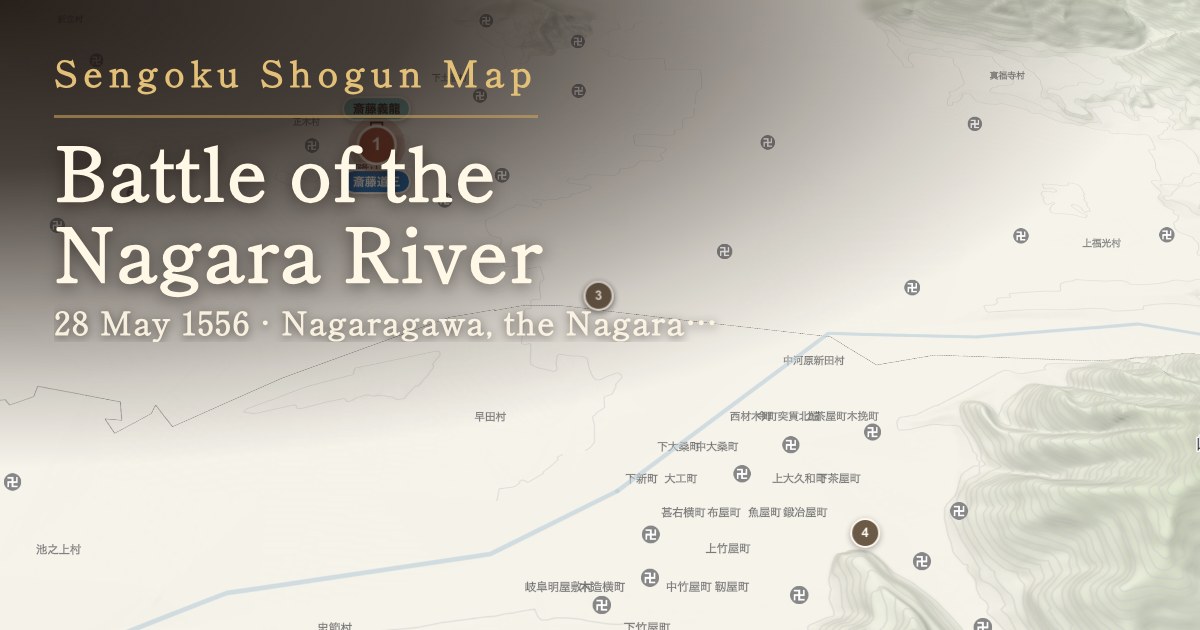
Course of the battle
1 1554–1555
Dōsan retires and father and son fall out
2 28 May 1556
The two armies clash on the Nagara River
Yoshitatsu brought out his troops and Dōsan came to the Nagara River. The difference in numbers was wide, and Dōsan's side was overwhelmed.
Attacks with the larger army
Sources12·Certainty: High
3 28 May 1556
Saitō Dōsan is killed
Dōsan was beaten and killed. His son-in-law Oda Nobunaga had sent relief, but it did not arrive in time, and he fell back to Owari under pursuit.
Points of debate
The tales of individual warriors who claimed Dōsan's head come from war chronicles and are treated here as tradition.
Sources125·Certainty: High
4 After the battle
Jōzai-ji becomes the memorial temple of the Saitō
Dōsan was first buried southwest of Sōfuku-ji; later the abbot of Jōzai-ji moved the grave to the present Dōsan mound. Jōzai-ji holds the memorial rites for three generations of the Saitō and preserves portraits of Dōsan and Yoshitatsu.
Takes Mino in hand
Sources126·Certainty: High
Historical significance
The lordship of Mino changed hands and its relation with Owari turned from alliance to enmity. Dōsan's remains were later moved to the Dōsan mound by the abbot of Jōzai-ji, the temple that holds the memorial tablets of three generations of the Saitō.
Key figures
斎藤道三方
2

Commander of Dōsan's side
He had given up the lordship of Mino and retired to Sagiyama Castle. He was beaten and killed on the Nagara River.
Sources1·Certainty: High

Relief force for Dōsan
As Dōsan's son-in-law he sent relief, but it came too late; he commanded the rear guard and withdrew to Owari.
Sources5·Certainty: Medium
斎藤氏
1
Commander of the Saitō army
The heir who had succeeded to the headship. He beat Dōsan with the larger army and took Mino in hand.
Sources3·Certainty: High
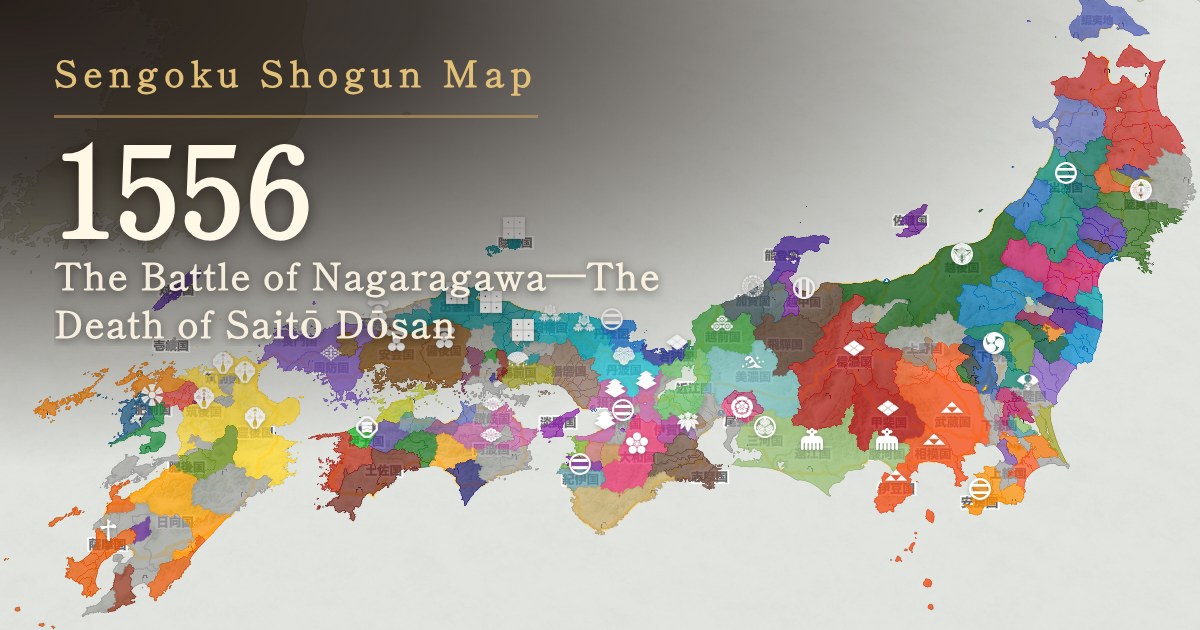
Other events of 1556
Notes on the data
Dates are given in the Western (Julian) calendar. The sources use the lunar calendar; 28 May corresponds to the twentieth day of the fourth month of Kōji 2. Troop numbers come from war tales and vary widely, so they are left out of the text.
Sources consulted
- 岐阜市「[市]道三塚」
- 岐阜市「ナビ番号:315 常在寺」
- 岐阜県歴史資料館「斎藤義龍肖像」
- 城郭マスタ(shiro.geojson)
- Wikipedia「長良川の戦い」
- 地理院地図 住所検索(岐阜県岐阜市梶川町9)
The numbers in the text refer to the list above. Certainty indicates how far a statement is supported by the cited sources; it does not refer to the precision of the coordinates or the dating.
Advertisement