INTERACTIVE BATTLE
Battle of Kitashirakawa
4 July 1558 · Shirakawa in Yamashiro Province (now Kitashirakawa, Sakyō Ward, Kyoto)
Shogun Ashikaga Yoshiteru, who had taken refuge in Ōmi, tried to win Kyoto back and fought the party of Miyoshi Nagayoshi over the castles of the Eastern Hills. He lost the battle, but a settlement later the same year brought him back to the capital after five years.
Background
Yoshiteru had been driven from the capital in his struggle with Miyoshi Nagayoshi and had withdrawn to Kutsuki in Ōmi; five years had passed. Backed by Rokkaku Yoshikata, he now pressed on Kyoto with Shōgunzan Castle in the Eastern Hills as his foothold.
Outcome
The Miyoshi won the clash at Kitashirakawa. Even so, in the eleventh month of the same year Nagayoshi and Yoshiteru came to terms, and Yoshiteru entered the capital, received at Shōkoku-ji.
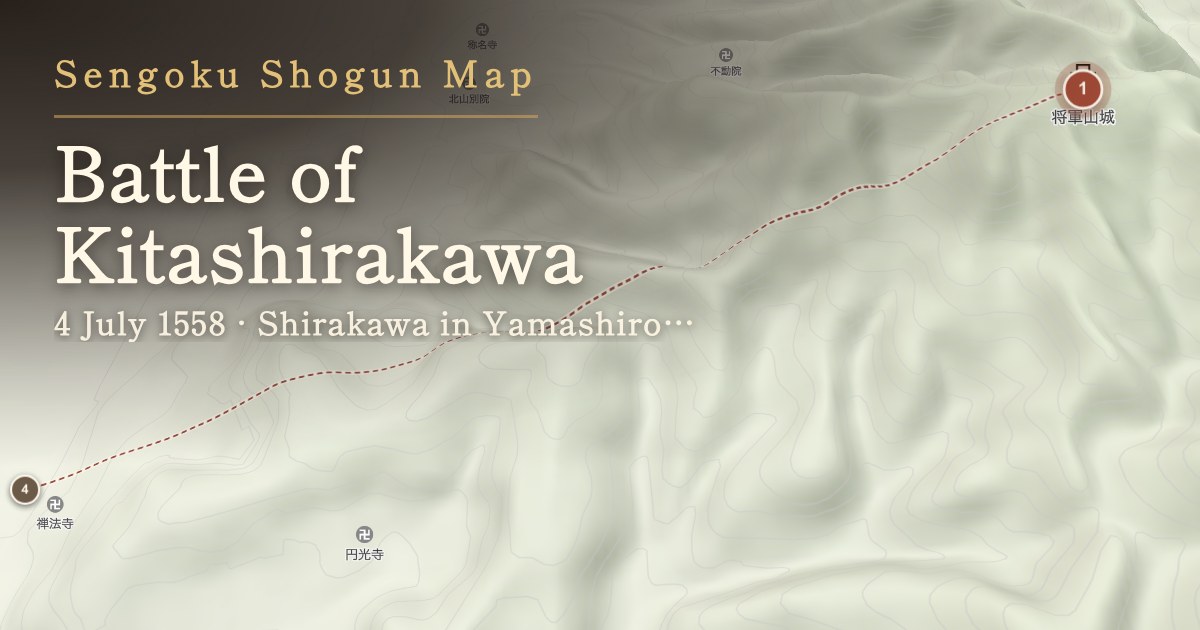
Course of the battle
1 Late June 1558
The Miyoshi seize Shōgunzan Castle
The Miyoshi occupied Shōgunzan Castle on Uryūzan in the Eastern Hills. Looking down on the capital, it had served as a strongpoint in every struggle for Kyoto.
Seizes Shōgunzan Castle
Sources13·Certainty: Medium
2 Early July 1558
The castle changes hands and the fight moves to Nyoigatake
To avoid being cut off, the Miyoshi set fire to the castle and pulled back, and it fell to the shogunal side. The next day the Miyoshi took Nyoigatake, southeast of Uryūzan, and beat the shogunal troops there.
Sources123·Certainty: Medium
3 4 July 1558
The two armies clash at Kitashirakawa
The two armies met head-on at Kitashirakawa and the Miyoshi won. Yoshiteru did not retake the capital by force.
Holds the capital
Sources124·Certainty: Medium
4 November 1558
Terms are reached and Yoshiteru returns to Kyoto
In the eleventh month of the same year Miyoshi Nagayoshi and Yoshiteru came to terms. Yoshiteru was received at Shōkoku-ji by Nagayoshi and entered the capital after five years away.
Enters the capital after five years
Sources124·Certainty: Medium
Historical significance
The Miyoshi won on the field, and then chose to bring the shogun back to the capital. The arrangement that held in the home provinces until the Eiroku Incident of 1565 was settled in this year.
Key figures
足利氏
2

Shogun, at the head of the shogunal side
The shogun in exile in Ōmi. He fought in the Eastern Hills to retake the capital, lost, and returned to it under the settlement of the same year.
Sources2·Certainty: High
General on the shogunal side
He supported Yoshiteru and took part in the attempt to retake the capital.
Sources2·Certainty: Medium
六角氏
1
Backer of the shogunal side
As the great lord of Ōmi he backed Yoshiteru, and he continued to weigh in the balance of the home provinces.
Sources2·Certainty: Medium
三好氏
3

Head of the Miyoshi
The man who held the capital. He won on the field and then chose to receive Yoshiteru back into it.
Sources2·Certainty: High
Miyoshi general
He led the seizure of Shōgunzan Castle and the fighting on Nyoigatake.
Sources2·Certainty: Medium

Miyoshi general
As one of the principal Miyoshi commanders he took part in the fighting in the Eastern Hills.
Sources2·Certainty: Medium
Other events of 1558
Notes on the data
Dates are given in the Western (Julian) calendar. The sources use the lunar calendar; 4 July corresponds to the ninth day of the sixth month of Eiroku 1. The castle is also called Uryūzan, Kitashirakawa and Shōgunzan; the form used here follows the castle master data. Casualty figures differ between sources and are left out of the text.
Sources consulted
- 京都府教育委員会 文化財保護課「北白川(勝軍山)城跡」
- Wikipedia「北白川の戦い」
- 城郭マスタ(shiro.geojson)
- 地理院地図 住所検索(京都府京都市左京区北白川上終町)
The numbers in the text refer to the list above. Certainty indicates how far a statement is supported by the cited sources; it does not refer to the precision of the coordinates or the dating.
Advertisement