INTERACTIVE BATTLE
Battle of Okehazama
12 June 1560 · Okehazama and Dengakuhazama, Owari Province
Oda Nobunaga attacked Imagawa Yoshimoto's main force around Okehazama and Dengakuhazama during Yoshimoto's invasion of Owari, and Yoshimoto was killed. The battle formed part of a wider struggle over Narumi and Odaka castles and the Oda forts that blockaded them.
Background
In the 1550s Narumi, Odaka and Kutsukake castles were held by the Imagawa. The Oda countered with Marune and Washizu forts against Odaka and Tange, Zenshoji and Nakajima forts against Narumi. In June 1560 Yoshimoto advanced into Owari while Imagawa forces supplied Odaka and moved to remove the Oda forts. The page does not assume that Kyoto was Yoshimoto's final objective, and presents the struggle over forts and supply routes in south-eastern Owari as the documented setting.
Outcome
Yoshimoto was killed and the Imagawa invasion of Owari stalled. Matsudaira Motoyasu left Odaka, passed through Daijuji and returned to Okazaki, but did not immediately join the Oda; he made peace and alliance with Nobunaga in 1561. Imagawa Ujizane's government also did not disappear immediately after the battle.
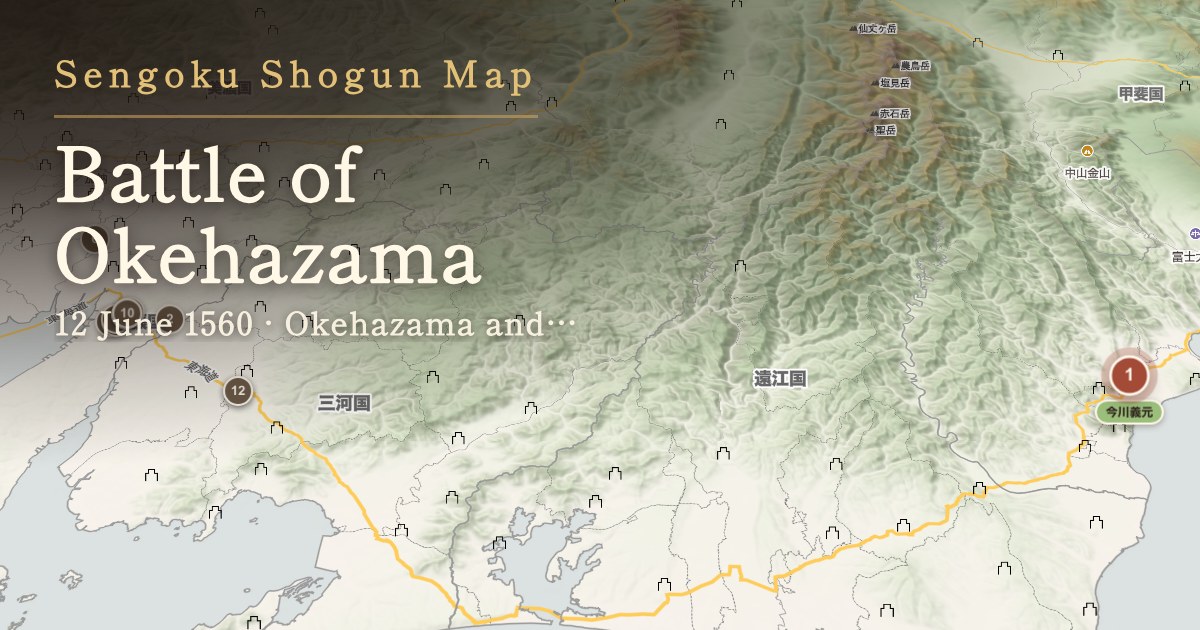
Course of the battle
1 3–5 June
The Imagawa army leaves Sunpu
Imagawa Yoshimoto led forces from Suruga, Totomi and Mikawa towards Owari.
Points of debate
The itinerary in local accounts includes later compilations, so each stop is not treated as fixed solely by contemporary evidence.
Leads the main force out of Sunpu
Sources25·Certainty: Medium
2 11 June
Yoshimoto's main force enters Kutsukake castle
Yoshimoto's main force entered Imagawa-held Kutsukake castle and is said to have prepared for operations in south-eastern Owari the next day.
Points of debate
The participants in the council and its precise plans are not fixed.
Holds council at Kutsukake castle
Sources56·Certainty: Medium
3 Night of 11–12 June
Matsudaira Motoyasu supplies Odaka castle
Motoyasu, serving the Imagawa, successfully supplied Odaka castle, which was pressed by Oda forts, and rested inside it.
Points of debate
The route, diversion and exact timing of the supply operation remain disputed.
Runs supplies into Odaka castle
Sources15·Certainty: High
4 Before dawn, 12 June
Marune fort falls
Imagawa troops including Matsudaira Motoyasu attacked Marune fort; its defender Sakuma Morishige and others are said to have fallen as the fort was taken.
Points of debate
Troop numbers and details of firearm use rely partly on later sources and are not treated as fixed.
Holds Marune fort
Attacks Marune fort
Sources7·Certainty: Medium
5 Before dawn, 12 June
Washizu fort falls
Imagawa troops under Asahina Yasutomo and others attacked Washizu fort; defender Io Sadamune and many of the garrison are said to have fallen as it was taken.
Points of debate
Sources differ over the numbers and composition of both forces.
Holds Washizu fort
Holds Washizu fort
Sources8·Certainty: Medium
6 Before dawn to morning, 12 June
Oda Nobunaga leaves Kiyosu castle
After learning of the attacks on the forts, Nobunaga left Kiyosu castle and headed through Atsuta towards the front in south-eastern Owari.
Points of debate
The Atsumori episode, the number present at departure and the prayer at Atsuta are famous Shinchoko-ki narratives and are kept distinct from the departure itself.
Rides out from Kiyosu castle
Sources25·Certainty: Medium
7 Morning, 12 June
Nobunaga advances to Zenshoji fort
Nobunaga advanced to Zenshoji fort and is said to have assembled his arriving troops there.
Points of debate
Sources differ over the assembled strength, so no fixed number is given.
Sources9·Certainty: Medium
8 Late morning, 12 June
The Oda advance from Zenshoji to Nakajima fort
Nobunaga advanced from Zenshoji to Nakajima fort, approaching the Imagawa troops and main force around Okehazama.
Points of debate
Several routes are proposed beyond Nakajima fort; the map line is not a single fixed route.
Encamped at Zenshoji fort
Holds Nakajima fort
Moves forward from Zenshoji to Nakajima fort
Sources9·Certainty: Disputed
9 Around noon, 12 June
The Oda attack the Imagawa main force
The Oda attacked the Imagawa main force, said to have been resting around Okehazama and Dengakuhazama, and the fighting became a melee.
Points of debate
Flanking-surprise and frontal-attack interpretations coexist; the rain's role and the location of Yoshimoto's headquarters are also unsettled.
Attacked while resting at Okehazama
Feints against the Imagawa vanguard
Attacks the Imagawa main force
Sources234·Certainty: Disputed
10 12 June
Yoshimoto is killed and the Imagawa withdraw
Yoshimoto was killed in the melee. Having lost its commander-in-chief, the Imagawa army turned to withdrawal from Owari.
Points of debate
The individual who killed Yoshimoto, the final combat and a single death site are separated as source narratives or traditions. Troop and casualty figures are also unsettled.
Killed in action
Holds Narumi castle
Sources23·Certainty: High
11 Night of 12 June to 16 June
Motoyasu leaves Odaka and withdraws towards Okazaki
After confirming Yoshimoto's death, Motoyasu left Odaka castle and entered Daijuji in Okazaki, the Matsudaira family temple.
Leaves Odaka and withdraws towards Okazaki
Sources15·Certainty: High
12 16 June 1560 to 1561
Motoyasu returns to Okazaki as Owari-Mikawa relations shift
After the Imagawa left Okazaki castle, Motoyasu entered it on the 23rd day of the fifth lunar month and regrouped the Matsudaira family and retainers. He initially still fought the Oda as an Imagawa adherent, making peace and alliance with Nobunaga in 1561.
Points of debate
The return to Okazaki is not equated with immediate independence from the Imagawa or the formation of the Kiyosu alliance.
Returns to Okazaki and later allies with Nobunaga
Makes peace with Motoyasu and enters alliance
Sources15·Certainty: High
Historical significance
The battle helped Nobunaga regain the military initiative in south-eastern Owari and gave Motoyasu an opening to regroup the Matsudaira retainers from Okazaki. Troop numbers, Yoshimoto's objective, Nobunaga's route of attack, the role of the sudden rain, and the locations of Yoshimoto's headquarters and death remain debated.
Key figures
織田氏
8

Commander-in-chief of the Oda army
The main force, said to have moved up from Kiyosu castle by way of Nakajima fort towards Okehazama.
Sources210·Certainty: Medium
Oda fort garrison and forward troops
Remembered as an Oda force stationed around Zenshoji fort. Sources differ on his exact position and part.
Sources11·Certainty: Disputed
Oda vanguard
Local records place him in a feint against the Imagawa vanguard. The details of his part vary between sources.
Sources11·Certainty: Disputed
Defender of Marune fort
Held Marune fort against the Imagawa attack and is said to have died with it.
Sources7·Certainty: Medium
Defender of Washizu fort
An Oda commander posted to Washizu fort. The Shinchoko-ki names him Oda Genba.
Sources48·Certainty: Medium
Defender of Washizu fort
Said to have been posted to Washizu fort with his son Naokiyo. The Shinchoko-ki names them the Io father and son.
Sources8·Certainty: Medium
Defender of Nakajima fort
Said to have held Nakajima fort, to which Nobunaga moved forward before making for Okehazama.
Sources14·Certainty: Medium
Defender of Tange fort
One of the Oda commanders posted to Tange fort, which held down Narumi castle.
Sources15·Certainty: Medium
今川氏
4

Commander-in-chief of the Imagawa
Said to have moved from Kutsukake castle towards Odaka and to have been attacked while resting near Okehazama and Dengakuhazama.
Sources12·Certainty: High

Imagawa commander
Succeeded in bringing supplies into Odaka castle and is said to have taken part in the attacks on Marune and Washizu. Later known as Tokugawa Ieyasu.
Sources17·Certainty: High
Imagawa defender of Narumi castle
Remembered as the Imagawa commander holding Narumi castle. His position within the main force on the day is not fixed.
Sources12·Certainty: Medium
Imagawa officer
Traditions of a camp site survive near Okehazama. The position is treated as a traditional location.
Sources13·Certainty: Traditional account
Other events of 1560
Notes on the data
Dates use the Western Julian calendar; 12 June corresponds to the 19th day of the fifth month of Eiroku 3. Lines and points on the map are approximate aids for understanding historic and traditional sites and movements. They do not establish a single route of attack, the battlefield's extent, or the exact locations of Yoshimoto's headquarters and death.
Sources consulted
- 国立公文書館「桶狭間の戦い」
- 豊明市「桶狭間古戦場伝説地」
- 名古屋市緑区「桶狭間周辺のみどころ一覧」
- 名古屋市博物館「五月の信長」
- 城郭マスタ(shiro.geojson)
- 豊明市「豊明市指定文化財・沓掛城址」
- 名古屋市緑区「大高周辺のみどころ一覧4」
- 名古屋市緑区「大高周辺のみどころ一覧3」
- 名古屋市緑区公式ウェブサイト
- 名古屋市緑区「鳴海周辺のみどころ」
- 名古屋市緑区資料(伝承を含む)
- 名古屋市緑区「鳴海周辺のみどころ一覧1」
- 名古屋市文化財資料(瀬名氏俊陣地跡)
- 名古屋市緑区公式ウェブサイト(中島砦周辺資料)
- 名古屋市緑区公式ウェブサイト(丹下砦周辺資料)
The numbers in the text refer to the list above. Certainty indicates how far a statement is supported by the cited sources; it does not refer to the precision of the coordinates or the dating.
Advertisement