INTERACTIVE BATTLE
The Suppression of the Echizen Ikkō-ikki
August, Tenshō 3 · Kinome Pass, Sugitsu, and Fuchū, Echizen Province (now around Minami-Echizen and Echizen, Fukui)
After the fall of the Asakura, the Ikkō-ikki had effectively ruled Echizen Province. Nobunaga's army crushed it with a two-pronged assault through Kinome Pass and Sugitsu. Afterward, Shibata Katsuie received eight districts of Echizen, while Maeda Toshiie, Sassa Narimasa, and Fuwa Mitsuji — the 'Three Men of Fuchū' — were granted the two Fuchū districts.
Background
After the Asakura fell in 1573, the Ikkō-ikki's rule of Echizen — administered by monk-officials dispatched from the Hongan-ji — bred growing resentment among local lords and peasants, and internal splits deepened by around 1575. Having defeated Takeda Katsuyori at Nagashino that May, Nobunaga seized on this division and moved to retake the province.
Outcome
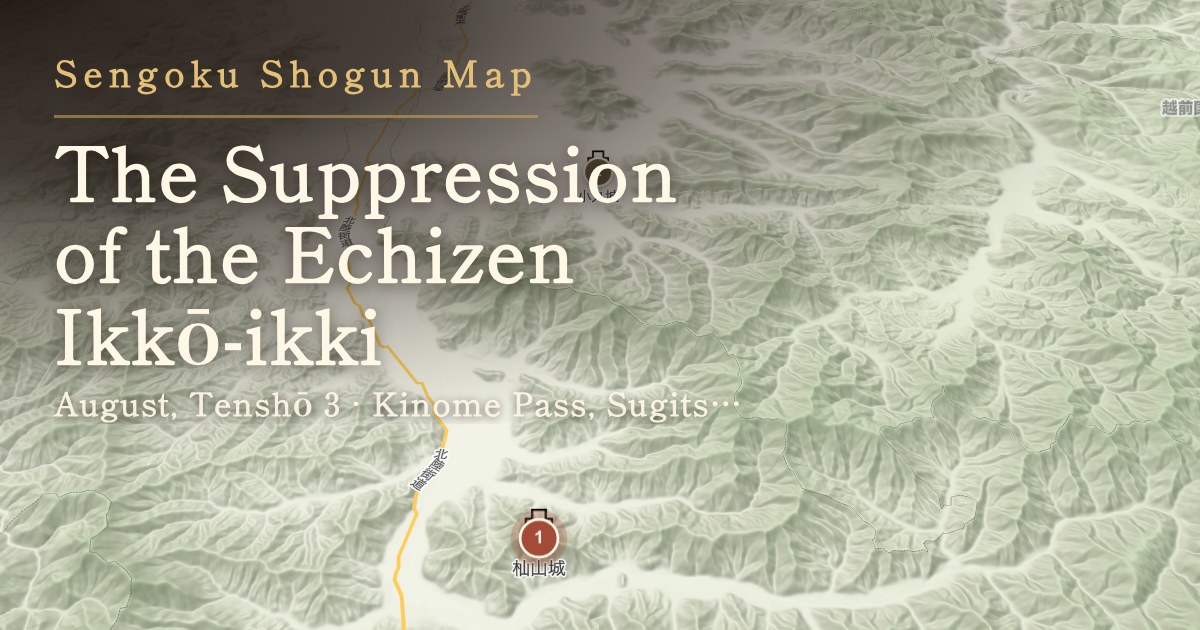
Nobunaga reached Tsuruga on August 14, 1575, and the next day launched a total assault through Kinome Pass (Niwa Nagahide, Takigawa Kazumasu, Hachiya Yoritaka) and Sugitsu (Hashiba Hideyoshi, Akechi Mitsuhide, Shibata Katsuie). The ikki's defenses collapsed, aided by the defection of Horie Kagetada, and over 1,500 were killed in Fuchū town on August 15–16 alone. The ikki's commander-in-chief, Shimotsuma Raishō, retreated to Toyohara-ji but was killed that October, ending the ikki's roughly eighteen-month rule of Echizen.
Course of the battle
1 August 15, 1575
The assault through Kinome Pass and SugitsuNobunaga, who had entered Tsuruga the day before, ordered a two-pronged assault through Kinome Pass (Niwa Nagahide, Takigawa Kazumasu, Hachiya Yoritaka) and Sugitsu (Hashiba Hideyoshi, Akechi Mitsuhide, Shibata Katsuie). The ikki's defenses collapsed, aided by the defection of Horie Kagetada at Sugitsu. Over the 15th and 16th, 1,500 were killed in Fuchū town alone.
Sources15·Certainty: High
2 September 2, 1575
The 'Three Men of Fuchū' are establishedNobunaga divided Echizen. Shibata Katsuie received eight districts and the right to build Kitanoshō castle. Maeda Toshiie, Sassa Narimasa, and Fuwa Mitsuji each received an equal share of the two Fuchū districts as the 'Three Men of Fuchū,' becoming Katsuie's auxiliaries and overseers of his rule.
Points of debate
No official source names Maeda Toshiie among the units of the August 15 assault itself. However, a roof-tile inscription excavated at Komaru Castle records that he had roughly 1,000 ikki fighters executed, suggesting deep involvement in the aftermath as one of the Three Men of Fuchū. The tile's date is disputed between 1575 and 1580.
Sources235·Certainty: High
Historical significance
On September 2, following the suppression, Nobunaga divided Echizen: Shibata Katsuie received eight districts and the right to build Kitanoshō castle, becoming the central figure of the Hokuriku army, while Maeda Toshiie, Sassa Narimasa, and Fuwa Mitsuji each received an equal share of the two Fuchū districts as the 'Three Men of Fuchū,' serving as Katsuie's auxiliaries and overseers. Oda-side records describe killings in the thousands to tens of thousands during the assault and the mop-up that followed (Nobunaga wrote of beheading 6,600 by August 21; the Shinchō Kōki gives 12,250 killed August 15–19 alone, and 30,000–40,000 including other commanders' totals). No official source names Maeda Toshiie among the units of the August 15 assault itself, but multiple official sources confirm his deep involvement, as one of the Three Men of Fuchū, in governing and dealing with the ikki's remnants around Fuchū afterward.
Key figures
織田氏
8

Commander-in-chief
He entered Tsuruga on August 14 and directed the total assault the next day, personally overseeing the mop-up and recording the number beheaded in his own letters.
Sources1·Certainty: High

Led the Sugitsu assault; received eight districts of Echizen afterward
He led the assault at Sugitsu together with Hashiba Hideyoshi and Akechi Mitsuhide. On September 2, after the suppression, he received eight districts of Echizen and the right to build Kitanoshō castle, becoming central to the Hokuriku army.
Sources1·Certainty: High

Took part in the Sugitsu assault
He took part in the Sugitsu assault alongside Shibata Katsuie and Akechi Mitsuhide.
Sources1·Certainty: High

Took part in the Sugitsu assault
He took part in the Sugitsu assault alongside Shibata Katsuie and Hashiba Hideyoshi.
Sources1·Certainty: High

Led the Kinome Pass assault
He led the assault at Kinome Pass together with Takigawa Kazumasu and Hachiya Yoritaka.
Sources1·Certainty: High

After the suppression, one of the 'Three Men of Fuchū' who governed the Fuchū districts
No official source names him among the units of the August 15 assault itself, but on September 2 he received, along with Sassa Narimasa and Fuwa Mitsuji, an equal share of the two Fuchū districts, becoming Shibata Katsuie's auxiliary and overseer. A roof-tile excavated at Komaru Castle records that he had roughly 1,000 ikki fighters executed (its date is disputed between 1575 and 1580).
Sources23·Certainty: Medium

After the suppression, one of the 'Three Men of Fuchū' who governed the Fuchū districts
He received, along with Maeda Toshiie and Fuwa Mitsuji, an equal share of the two Fuchū districts. Komaru Castle is said to have been begun by him in 1575.
Sources2·Certainty: Medium
After the suppression, one of the 'Three Men of Fuchū' who governed the Fuchū districts
He received, along with Maeda Toshiie and Sassa Narimasa, an equal share of the two Fuchū districts.
Sources2·Certainty: Medium
本願寺・一向一揆
1
Commander-in-chief of the ikki
The ikki commander-in-chief, dispatched by the Hongan-ji and based at Toyohara-ji in Sakai district. He retreated there after the assault but was killed in October by Takada-school Shōmyō-ji followers at Shimono village.
Sources1·Certainty: High
Other events of 1575
Notes on the data
殺害された人数は信長方の記録(信長書状で6600人、『信長公記』で1万2250〜3〜4万人)に幅があり、単一の確定数値としては断定していない。小丸城跡出土の文字瓦には前田利家が一揆勢約1000人を処刑した旨が刻まれているが、瓦文の年代(天正3年か天正8年か)は学術的に未確定のため、本文では年表項目として採用せず、注記に留める。
Sources consulted
- 福井県立図書館・文書館『福井県史』通史編3 近世一「信長の越前侵攻と一揆の壊滅」
- 福井県立図書館・文書館『福井県史』通史編3「柴田勝家の越前支配――越前の国割」
- 福井県立図書館・文書館「図説福井県史 中世22 越前一向一揆(2)」
- 福井市立郷土歴史博物館「柴田勝家―北庄に掛けた夢とプライド」
- 城郭マスタ(shiro.geojson)
The numbers in the text refer to the list above. Certainty indicates how far a statement is supported by the cited sources; it does not refer to the precision of the coordinates or the dating.
Advertisement