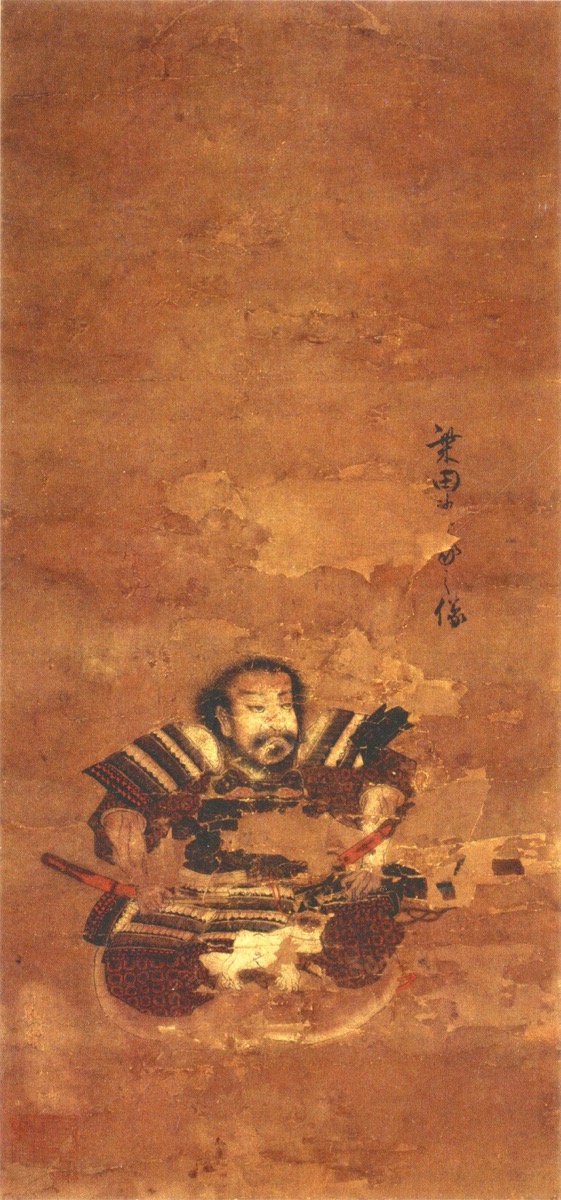
 作者不詳「柴田勝家像」
Senior Oda retainer: Hokuriku region
Shibata Katsuie
柴田勝家
birth year unknown – 1583
Senior retainer to Oda Nobunaga responsible for military campaigns and administrative reorganization in the Hokuriku region. Following the suppression of the Echizen Ikkō Uprising in September 1575, he was granted Echizen Kitasho by Nobunaga, which he developed as a hub connecting maritime traffic from the Sea of Japan with military operations toward the various Hokuriku domains. Campaigns into Kaga, Noto, and Etchū were not Katsuie's alone but occurred through cooperation with officers such as Maeda Toshiie, Sassa Narimasa, and Fuwa Mitsukuni, castles, ports, and regional lords. When Nobunaga died in 1582, Katsuie, stationed in Hokuriku, found it difficult to directly intervene in the capital's politics; the conflict with Hideyoshi after the Kiyosu Conference and the outcome of the Shizugatake and Kitasho campaigns in 1583 cannot be separated from the context of Hokuriku rule. The alias 'Demon Shibata' and his harsh character image depend heavily on later military narratives and biographical accounts.
Sources 福井市立郷土歴史博物館「柴田勝家―北庄に掛けた夢とプライド」/滋賀県「賤ヶ岳合戦と城砦群」/国立国会図書館レファレンス協同データベース「柴田勝家書状」
Related events
11
1556
Month 9
Battle of Inō
Main force of the Nobuyuki sideOda Nobunaga beat Shibata Katsuie and Hayashi Hidesada, who had raised his brother Nobuyuki, on the plain of Inō, and secured his place within the Oda Danjōnojō house.
1570
7/30
Battle of Anegawa
Oda commanderBetrayed by Azai Nagamasa at Kanegasaki, Oda Nobunaga marched into Omi with Tokugawa Ieyasu and met the Azai and Asakura at the Anegawa. The Oda and Tokugawa won the day but did not destroy the Azai.
1575
Month 8
The Suppression of the Echizen Ikkō-ikki
Led the Sugitsu assault; received eight districts of Echizen afterwardAfter the fall of the Asakura, the Ikkō-ikki had effectively ruled Echizen Province. Nobunaga's army crushed it with a two-pronged assault through Kinome Pass and Sugitsu. Afterward, Shibata Katsuie received eight districts of Echizen, while Maeda Toshiie, Sassa Narimasa, and Fuwa Mitsuji — the 'Three Men of Fuchū' — were granted the two Fuchū districts.
Month 9
Shibata Katsuie Receives Kitanoshō in Echizen
Lord of Echizen provinceAfter the suppression of the Echizen Ikkō uprising, Oda Nobunaga entrusted Shibata Katsuie with eight districts of Echizen and the northern campaign. Katsuie began developing Kitanoshō Castle and its town.
1576
9/11
Shibata Katsuie Issues a Free-Market Ordinance at Kitanoshō
Lord of Echizen provinceShibata Katsuie issued a free-market ordinance at Kitanoshō to encourage commerce in the castle town and consolidate his rule in Echizen.
1580
Month 1
The Fall of Oyama Gobo
Commander of the Hokuriku armyAfter Nobunaga's peace with the Ishiyama Hongan-ji, Sakuma Morimasa, serving under Shibata Katsuie, took Oyama Gobo, the headquarters of the Kaga Ikkō-ikki. The fall of its nearly century-old center brought Kaga under effective Oda control.
1582
4/3
Shibata Katsuie and the Oda Army Besiege Uozu Castle
Oda commander in chiefShibata Katsuie, Maeda Toshiie, Sassa Narimasa, and other Oda commanders surrounded Uozu Castle, a key Uesugi stronghold. The siege lasted about eighty days.
6/22
Fall of Uozu Castle
Took part / involvedAn Oda coalition led by Shibata Katsuie, Maeda Toshiie, and Sassa Narimasa captured Uozu Castle from the Uesugi side. The Oda forces withdrew after learning of the Honnō-ji Incident.
Month 7
Council at Kiyosu
Senior retainerAt Kiyosu Castle, Oda succession and territorial redistribution were discussed. Nobunaga's grandson Sanbōshi was chosen as heir over Oda Nobukatsu and Nobutaka, strengthening Hashiba Hideyoshi's influence.
1583
6/11
Battle of Shizugatake
Took part / involvedThe armies of Hashiba Hideyoshi and Shibata Katsuie fought around Shizugatake in Ika District, Ōmi Province, and the Shibata army was defeated.
6/14
Fall of Kitanoshō Castle
Took part / involvedAfter retreating from Shizugatake, Shibata Katsuie was attacked by Hashiba forces at Kitanoshō Castle and took his own life with Lady Oichi.
Advertisement