INTERACTIVE BATTLE
Honnoji Incident
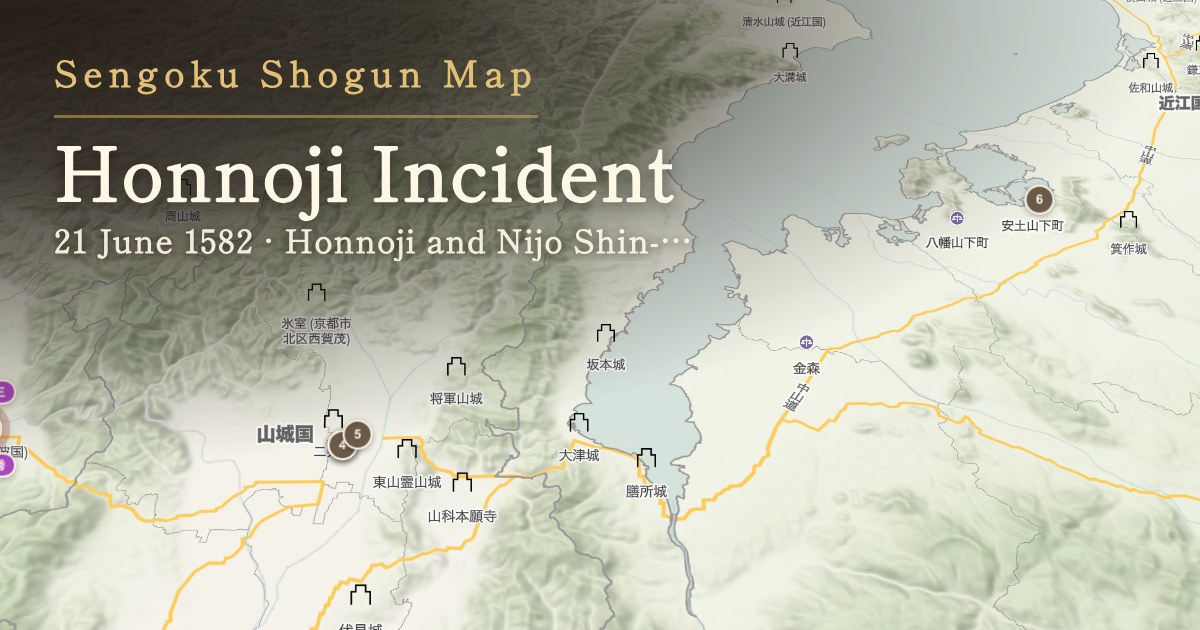
21 June 1582 · Honnoji and Nijo Shin-gosho, Yamashiro Province
Akechi Mitsuhide attacked his lord Oda Nobunaga at Honnoji in Kyoto, driving Nobunaga and his heir Nobutada to their deaths. The Oda regime, on the verge of unifying the country, collapsed in a single night.
Background
Nobunaga had come up to Kyoto to support the campaign against the Mori and was staying at Honnoji with only a small guard. His heir Nobutada was also in the capital. Mitsuhide, ordered west, was at Tanba Kameyama castle, and his army turned instead towards Kyoto.
Outcome
Nobunaga and Nobutada both died and the centre of the Oda house was lost. Mitsuhide seized Omi and tried to take power, but was defeated by Hashiba Hideyoshi at Yamazaki eleven days later.
Course of the battle
1 afternoon, 20 June
Mitsuhide sets out from Tanba Kameyama castle
Ordered west to the Chugoku front, Mitsuhide left Kameyama castle with thirteen thousand men. The road he took ran east, towards Kyoto, not west.
Points of debate
When he settled on rebellion, and at what point he told his retainers, differ between sources.
Sets out from Tanba Kameyama castle
Leads the core of the Akechi army
Sources13·Certainty: Disputed
2 before dawn, 21 June
Across the Katsura river into Kyoto
The army crossed the Oi pass and the Katsura river and entered Kyoto before first light. Nobunaga’s guard numbered about a hundred, with nothing that could be called a defence.
Enters Kyoto in the lead
Sources12·Certainty: Medium
3 dawn, 21 June
Honnoji is surrounded
At daybreak the Akechi ringed Honnoji. Mori Naritoshi and the other pages fought back, but the difference in numbers could not be answered.
Fights back at Honnoji
Sources12·Certainty: High
4 morning, 21 June
Oda Nobunaga takes his own life
Fire caught the temple and Nobunaga went within and killed himself. His body, it is said, was never found.
Points of debate
Because no body was confirmed, later embellishment has worked its way into accounts of his end.
Takes his own life at Honnoji
Sources12·Certainty: Medium
5 around midday, 21 June
Oda Nobutada dies at Nijo Shin-gosho
His heir Nobutada, staying at Myokakuji, moved to the neighbouring Nijo Shin-gosho and made a stand. That too could not be held, and Nobutada killed himself. The head of the Oda house and his successor were lost on the same day.
Takes his own life at Nijo Shin-gosho
Sources14·Certainty: High
6 24 June
Mitsuhide enters Azuchi castle
Mitsuhide moved into Omi and secured Azuchi castle, taking the Oda treasury and the centre of their rule. But Hosokawa Fujitaka and Tsutsui Junkei did not stir, and the support he had counted on never came.
Secures Azuchi castle
Sources13·Certainty: Medium
Historical significance
Unification lost its centre and the struggle over the succession began. No account of Mitsuhide’s motive has become settled; the theories stand side by side.
Key figures
明智氏
3

Commander of the attacking force
Turned his army back from Tanba Kameyama castle and attacked Nobunaga at Honnoji.
Sources1·Certainty: High
Senior retainer of the Akechi
Led the core of the Akechi army.
Sources1·Certainty: Medium
Akechi commander
Said to have led the advance.
Sources1·Certainty: Medium
織田氏
3

Head of the Oda house, attacked
Attacked while staying at Honnoji with only a small guard, and took his own life.
Sources1·Certainty: High
Heir to the Oda house
Moved from Myokakuji to Nijo Shin-gosho, made a stand there, and took his own life.
Sources1·Certainty: High

Page to Nobunaga
Said to have fallen at Honnoji at Nobunaga's side. Known by the name Ranmaru.
Sources1·Certainty: Traditional account
Other events of 1582
Notes on the data
Dates are given in the Western (Julian) calendar. The sources use the lunar calendar; 21 June here corresponds to the 2nd day of the 6th month of Tensho 10. The position of Nijo Shin-gosho is inferred from the address of its memorial stone; nothing of the building survives.
Sources consulted
- Wikipedia「本能寺の変」
- Wikipedia「本能寺」
- 城郭マスタ(shiro.geojson)
- 二条殿址碑の所在地(京都市中京区両替町通御池上る東側 金吹町)から推定
The numbers in the text refer to the list above. Certainty indicates how far a statement is supported by the cited sources; it does not refer to the precision of the coordinates or the dating.
Advertisement