POLITICAL EVENT
The Kiyosu Conference
1582 (27th day of the 6th month, Tenshō 10) · Kiyosu Castle, Owari Province
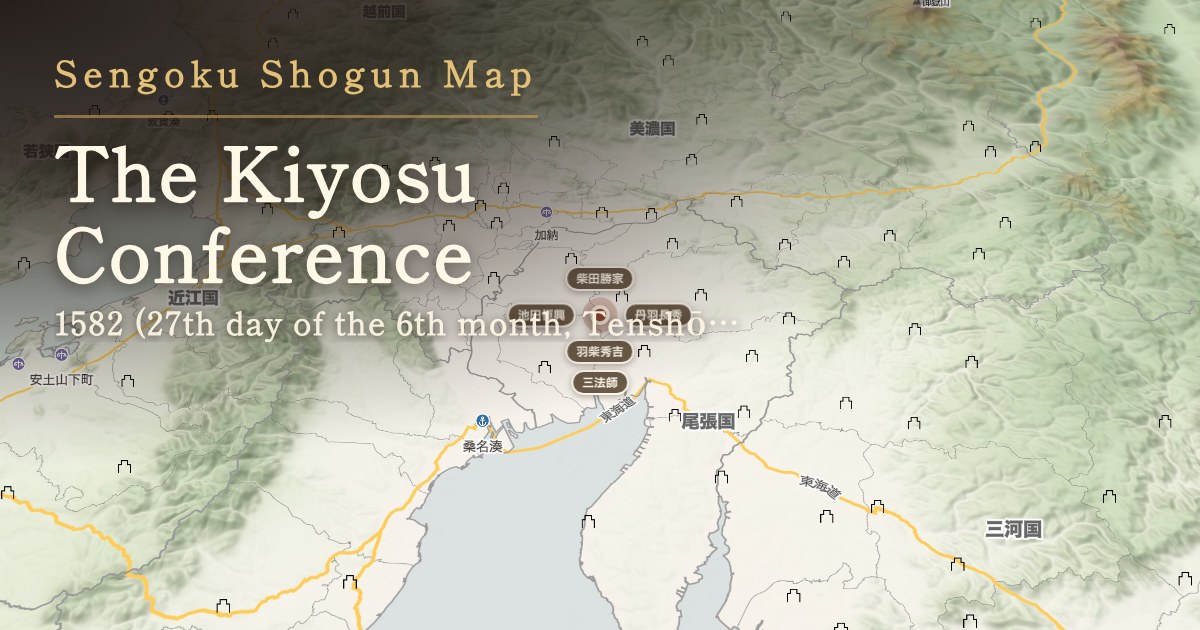
After Oda Nobunaga and his heir Nobutada died at Honnōji, four senior retainers — Shibata Katsuie, Hashiba Hideyoshi, Niwa Nagahide and Ikeda Tsuneoki — met at Kiyosu Castle in Owari to settle the Oda succession and the division of Nobunaga's lands. Nobunaga's infant grandson Sanbōshi took the headship; Nobukatsu received Owari and Nobutaka received Mino.
Background
Nobunaga was killed at Honnōji and his heir Nobutada died at much the same time, leaving open both who would head the Oda house and who would administer Nobunaga's former lands. Hideyoshi, who had beaten Akechi Mitsuhide at Yamazaki, was now strong in the capital region, but Nobunaga's sons Nobukatsu and Nobutaka and the senior retainer Shibata Katsuie each stood differently. The four senior retainers gathered at Kiyosu to fill that vacancy, settling the succession and the division of the lands.
Outcome
Sanbōshi took the headship of the Oda house, Nobukatsu received Owari and Nobutaka received Mino. Nobutaka was placed at Gifu Castle as Sanbōshi's guardian. Nobukatsu became lord of Kiyosu Castle and rebuilt the castle and its town on a large scale. After the conference Nobunaga's sister Oichi married Shibata Katsuie.
Course of the battle
1 July 1582
The four senior retainers meet at Kiyosu Castle
After Oda Nobunaga and his son died at Honnōji, the four senior retainers — Shibata Katsuie, Hashiba Hideyoshi, Niwa Nagahide and Ikeda Tsuneoki — gathered at Kiyosu Castle to settle the Oda succession and the division of Nobunaga's lands.
Attends the council at Kiyosu castle
Attends the council at Kiyosu castle
Attends the council at Kiyosu castle
Attends the council at Kiyosu castle
Succeeds as heir of the Oda house
Sources49·Certainty: High
Historical significance
The settlement did not hand the Oda house to a single adult head; it rearranged the relations between an infant heir and several powerful men. Afterwards Shibata Katsuie backed Oda Nobutaka against Hashiba Hideyoshi, and the quarrel led to the Battle of Shizugatake the following year.
People involved

One of the four senior retainers at the conference
Came to the conference fresh from the victory at Yamazaki. The city of Kiyosu says he took the lead there; scholarship also reads his position as having shifted through a political process that continued after the meeting.
Sources16·Certainty: Medium

One of the four senior retainers at the conference
A leading retainer of the Oda. After the conference he backed Oda Nobutaka against Hideyoshi, and the quarrel led to Shizugatake the following year.
Sources36·Certainty: High

One of the four senior retainers at the conference
Attended alongside Katsuie and Hideyoshi. His standing mattered in working out how the Oda house would be run around the infant Sanbōshi.
Sources6·Certainty: High
One of the four senior retainers at the conference
One of the four senior retainers present at the conference on the 27th day of the 6th month of Tenshō 10, with Katsuie, Hideyoshi and Nagahide.
Sources6·Certainty: High
Nobunaga's grandson, who took the headship of the Oda house
Nobutada's son. The conference made him head of the Oda house. Being an infant, real political and military initiative rested on the relations among the powerful men around him. Later known as Oda Hidenobu.
Sources27·Certainty: High

Nobunaga's second son, who received Owari
Received Owari and became lord of Kiyosu Castle, rebuilding the castle and its town on a large scale. In 1584 he broke with Hideyoshi and allied with Tokugawa Ieyasu.
Sources234·Certainty: High
Nobunaga's third son, who received Mino
Received Mino and was placed at Gifu Castle as Sanbōshi's guardian. He later joined Shibata Katsuie against Hideyoshi, was defeated in 1583 and took his own life.
Sources236·Certainty: High
Other events of 1582
Notes on the data
Dates follow the Japanese calendar of the sources (27th day of the 6th month, Tenshō 10). The heading gives only the year, because the basis for converting the date has not been sufficiently checked. On what was actually at issue, municipal accounts describe the meeting as deciding who would succeed Nobunaga, while scholarship treats Sanbōshi's succession as a given and the immediate purpose as naming his guardian. This page records the conference as a meeting that settled the succession and the division of the lands, and keeps any judgement of Hideyoshi's personal leadership separate from the established facts. Later war tales depict the speeches, seating and confrontations in detail; the sources and studies consulted here cannot reconstruct the exchanges, so they are not reproduced.
Sources consulted
- 清須市「清須の人物伝」
- 江南市「織田信雄禁制」
- 愛知県公文書館「愛知の歴史資料」
- 清須市「清洲城」
- あいち歴史観光「愛知ゆかりの武将・姫『織田家』」
- 滋賀県「賤ヶ岳の戦いから小牧・長久手の戦いへ」
- 文教大学教育学部・中村修也「清須会議の意味」
- 大阪大学学術情報庫「豊臣政権形成過程」
- 城郭マスタ(shiro.geojson)
The numbers in the text refer to the list above. Certainty indicates how far a statement is supported by the cited sources; it does not refer to the precision of the coordinates or the dating.
Advertisement