INTERACTIVE BATTLE
Battle of Inō
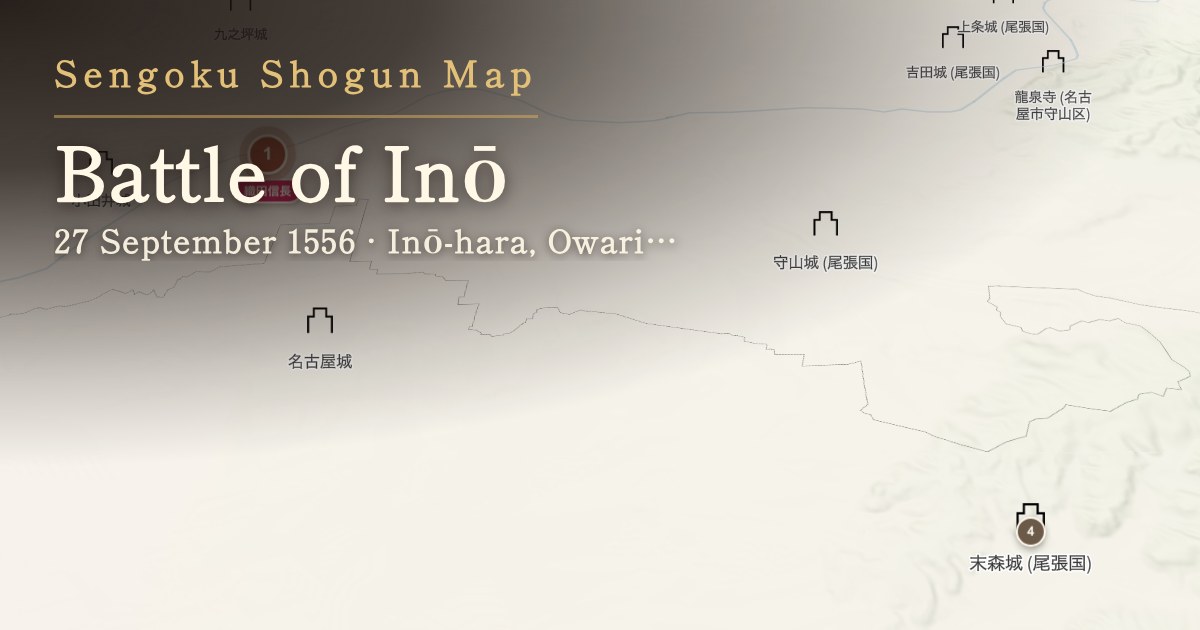
27 September 1556 · Inō-hara, Owari Province (now around Nazuka, Nishi Ward, Nagoya)
A fight over the headship of the Oda Danjōnojō house, between Oda Nobunaga and the party of Shibata Katsuie and Hayashi Hidesada, who had raised his brother Nobuyuki. Nobunaga built a fort at Nazuka to meet them and won on the plain of Inō.
Background
Nobunaga had taken Kiyosu Castle in 1555 and moved his seat there, but the headship of the Oda Danjōnojō house was not settled. The senior retainers Hayashi Hidesada and Shibata Katsuie raised his brother Nobuyuki, who held Suemori Castle, and the break came into the open.
Outcome
The outnumbered Nobunaga won. Nobuyuki, Hayashi Hidesada and Shibata Katsuie were pardoned through the intercession of Nobunaga's mother. Nobuyuki was killed by Nobunaga in 1557, and the quarrel ended there.
Course of the battle
1 Late September 1556
Nobunaga builds a fort at Nazuka
Faced with Nobuyuki's move, Nobunaga had a fort thrown up in the precinct of Nazuka Hakusan Shrine, on the Shōnai River between Kiyosu and Suemori.
Has the fort at Nazuka built
Sources13·Certainty: Medium
2 27 September 1556
The two armies meet on the plain of Inō
Nobuyuki's troops under Shibata Katsuie and Hayashi Michitomo attacked the fort and met Nobunaga's men on the plain of Inō near the Shōnai River. The attackers had the greater numbers.
Leads Nobuyuki's main force
Sends troops for Nobuyuki
Sources123·Certainty: Medium
3 27 September 1556
Nobunaga's men push back and win
Nobunaga's men pushed back; Hayashi Michitomo was killed and Nobuyuki's line broke. The dead were left on the plain, and the city of Nagoya records that local people raised a mound and buried them.
Points of debate
The account in which Nobunaga broke the enemy by shouting at them himself belongs to the Shinchō kōki tradition and is treated here as anecdote.
Fights at the front himself
Sources13·Certainty: Medium
4 After the battle
Nobuyuki withdraws to Suemori Castle and is pardoned
The defeated Nobuyuki withdrew to Suemori Castle. Nobunaga moved against it, but through the intercession of their mother Nobuyuki, Hayashi Hidesada and Shibata Katsuie were pardoned. Nobuyuki was killed the following year.
Withdraws to Suemori Castle
Sources24·Certainty: Medium
Historical significance
The battle fixed Nobunaga's position inside his own house and set him on the way to uniting Owari. From here his opponents were outside the family, above all the Iwakura-Oda clan.
Key figures
織田氏
2

Commander of Nobunaga's army
He came out from Kiyosu Castle, held the fort at Nazuka and broke Nobuyuki's army on the plain of Inō.
Sources1·Certainty: High
Commander of the fort at Nazuka
He is said to have built the fort at Nazuka on Nobunaga's order and to have held it.
Sources2·Certainty: Medium
織田信行方
3
Head of Nobuyuki's party
Nobunaga's brother, raised by the retainers from his seat at Suemori Castle. He was pardoned after his defeat but killed the next year.
Sources1·Certainty: High

Mainstay of Nobuyuki's army
He raised Nobuyuki and led his troops. He later became one of Nobunaga's chief retainers.
Sources1·Certainty: High
Senior retainer of the Oda house
With Katsuie he raised Nobuyuki. His brother Hayashi Michitomo is said to have been killed in this battle.
Sources2·Certainty: Medium
Other events of 1556
Notes on the data
Dates are given in the Western (Julian) calendar. The sources use the lunar calendar; 27 September corresponds to the twenty-fourth day of the eighth month of Kōji 2. Troop numbers come from war tales and vary widely, so they are left out of the text. The extent of Nazuka fort is not established, and the point on the map is placed at Nazuka Hakusan Shrine in Nishi Ward, Nagoya.
Sources consulted
- 名古屋市「庄内学区(西区)の紹介」
- Wikipedia「稲生の戦い」
- 地理院地図 住所検索(愛知県名古屋市西区名塚町)
- 城郭マスタ(shiro.geojson)
The numbers in the text refer to the list above. Certainty indicates how far a statement is supported by the cited sources; it does not refer to the precision of the coordinates or the dating.
Advertisement