INTERACTIVE BATTLE
Battle of Moji Castle
November – December 1561 · Moji Castle, Buzen Province (now Moji Ward, Kitakyushu)
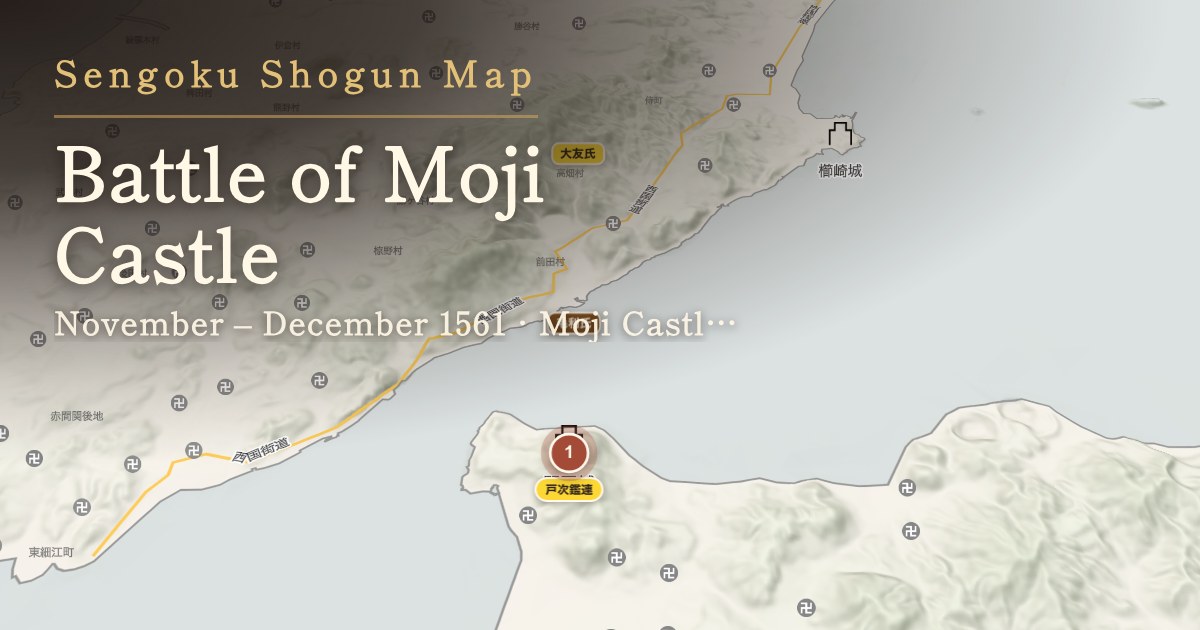
The Ōtomo laid siege to Moji Castle, which looks down on the Kanmon Strait, and a Mōri force that crossed the water held it. The boundary between the two powers across the strait was settled by this fight.
Background
The fall of the Ōuchi moved the boundary of power on either side of the Kanmon Strait. The Mōri made Moji Castle their foothold on Kyushu, while the Ōtomo sought to secure Buzen and Chikuzen. Kitakyushu records that in the late Muromachi period the Moji peninsula served as a base for the Ōtomo, the Ōuchi and the Mōri.
Outcome
The Ōtomo lifted the siege and withdrew, and Moji Castle stayed in Mōri hands. Mōri influence reached the local houses of Chikuzen and Buzen, and the struggle with the Ōtomo went on.
Course of the battle
1 Autumn 1561
The Ōtomo army invests Moji Castle
Under Ōtomo Sōrin, Bekki Akitsura and others brought up troops and invested Moji Castle. The castle stands on Kojōsan above the Kanmon Strait, commanding the roads by sea and by land at once.
Invests Moji Castle
Sources134·Certainty: Medium
2 About November 1561
Kobayakawa Takakage crosses over and enters the castle
The Mōri used their fleet to bring men in from the sea, and Kobayakawa Takakage crossed over into Moji Castle. Command of the water was what kept the besieged castle supplied.
Crosses over and enters the castle
Sources134·Certainty: Medium
3 About December 1561
The Ōtomo lift the siege and withdraw
A detached Mōri force struck the flank and rear of the Ōtomo army, which lifted the siege and withdrew. Moji Castle remained in Mōri hands.
Points of debate
There is a record that a Portuguese ship lying at Hakata joined in the bombardment, though it is thought not to have been on a scale that decided the outcome.
Directs the Buzen operation
Withdraws without taking Moji
Sources134·Certainty: Medium
Historical significance
The struggle over Moji was repeated over several years from 1558, and the fighting of 1561 was the largest of them. Holding the Kanmon Strait meant holding the sea road of western Japan, which is why both sides kept returning to it.
Key figures
毛利氏
3

Commanded the Mōri fleet
He crossed the strait, entered Moji Castle and stiffened its defence.
Sources3·Certainty: Medium
Head of the main Mōri house
He directed the operation in Buzen and kept the foothold on Kyushu.
Sources3·Certainty: Medium
Mōri naval commander
He is said to have carried men in by sea and struck the flank and rear of the Ōtomo army.
Sources3·Certainty: Medium
大友氏
3
Head of the Ōtomo house
He sent his army against Moji Castle in order to secure Buzen and Chikuzen, but did not take it.
Sources3·Certainty: Medium
Chief commander of the Ōtomo army
He directed the siege of Moji Castle. He later took the name Tachibana Dōsetsu.
Sources3·Certainty: Medium
Ōtomo general
He led one of the divisions of the Ōtomo army in the attack on Moji Castle.
Sources3·Certainty: Medium
Other events of 1561
Notes on the data
Dates are given in the Western (Julian) calendar. The sources use the lunar calendar; Kobayakawa Takakage's crossing on the tenth day of the tenth month and the Ōtomo withdrawal on the fifth day of the eleventh fall in November and December 1561. Because the sources do not agree closely enough to fix days, only months are shown. The castle site lies in today's Mekari Park on Kojōsan.
Sources consulted
- 北九州市「門司あれこれ探訪③ 門司城跡」
- 北九州市「和布刈公園」
- Wikipedia「門司城の戦い」
- 城郭マスタ(shiro.geojson)
The numbers in the text refer to the list above. Certainty indicates how far a statement is supported by the cited sources; it does not refer to the precision of the coordinates or the dating.
Advertisement