INTERACTIVE BATTLE
Fourth Battle of Kawanakajima
18 October 1561 · Kawanakajima battlefield (Hachimanbara)
Takeda Shingen and Uesugi Masatora met head-on across the Kawanakajima plain between the Chikuma and Sai rivers. Both sides suffered heavily and nothing was decided.
Background
Masatora, back from his campaign in the Kantō, marched again at the call of the local houses of northern Shinano. The Takeda had made Kaizu Castle, today's Matsushiro, their forward base.
Outcome
In the hard fighting at Hachimanbara the Takeda lost Shingen's second-in-command, his brother Nobushige, among others, and the Uesugi were badly cut up as well. Both armies left the field and no victory was decided.
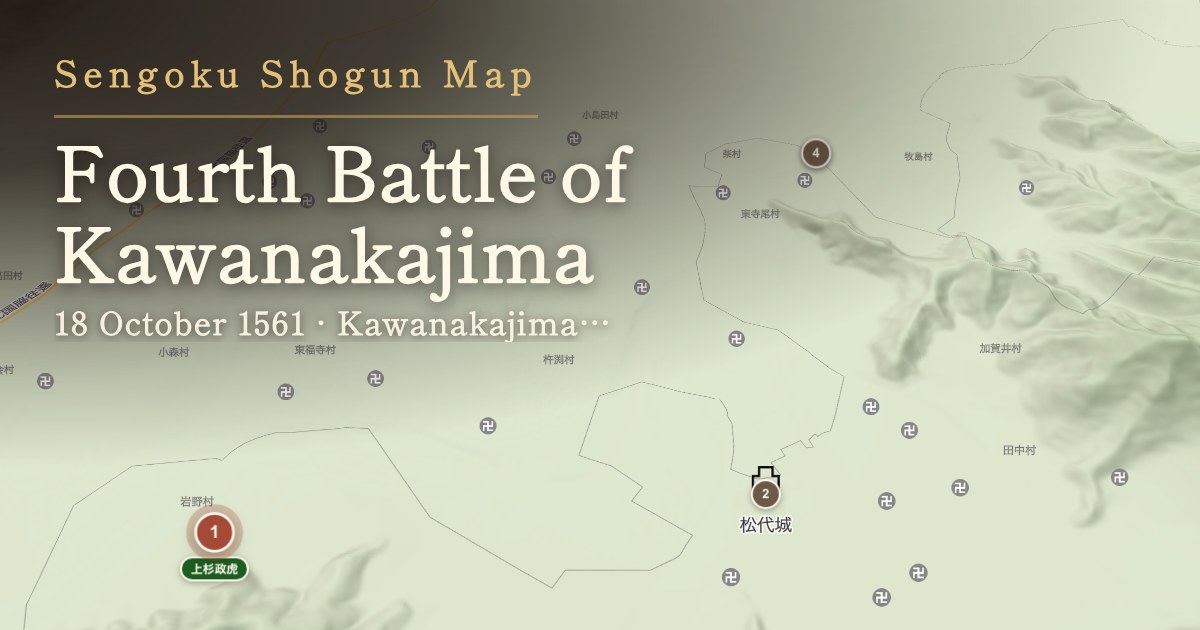
Course of the battle
1 Autumn 1561
The Uesugi army takes position on Saijoyama
Masatora, back from the Kantō, marched into northern Shinano and is said to have taken position on Saijoyama, which overlooks the Kawanakajima plain.
Takes position on Saijoyama
Sources34·Certainty: Medium
2 Autumn 1561
The Takeda army moves out from Kaizu Castle
The Takeda came out from Kaizu Castle, their forward base in northern Shinano, and advanced onto the Kawanakajima plain. Kaizu is the castle known today as Matsushiro.
Marches out from Kaizu Castle
Sources35·Certainty: Medium
3 18 October 1561
The two armies clash at Hachimanbara
The two armies met head-on at Hachimanbara. The city of Nagano describes it as a hard-fought battle that left many legends behind, among them the single combat of Shingen and Kenshin.
Points of debate
The woodpecker stratagem and the single combat of Shingen and Kenshin come from later military writings such as the Kōyō gunkan. Some now read the battle as a chance encounter, and neither the dispositions nor the course of the fighting is settled.
Sources12·Certainty: Disputed
4 18 October 1561
Both sides are cut up and nothing is decided
The Takeda lost Shingen's second-in-command, his brother Nobushige, among others, and the Uesugi were badly cut up as well. Both armies left the field with nothing decided. A burial mound for the fallen still stands at Hachimanbara.
Said to have fallen
Said to have fallen
Sources12·Certainty: Medium
Historical significance
It is remembered as the hardest of the five confrontations at Kawanakajima and left many legends behind. Even so, Kaizu Castle and the Takeda hold on northern Shinano survived the battle, and the Uesugi gained no lasting possession.
Key figures
上杉氏
2

Commander of the Uesugi army
He marched out immediately after returning from the Kantō and is said to have pressed close to the Takeda headquarters. Later known as Uesugi Kenshin.
Sources1·Certainty: Medium

Local lord of northern Shinano
Driven from his own lands by the Takeda, he pressed the Uesugi to march into northern Shinano.
Sources3·Certainty: Medium
武田氏
3

Commander of the Takeda army
He kept his hold on northern Shinano with Kaizu Castle as its pivot and met the Uesugi at Hachimanbara.
Sources1·Certainty: Medium
Second-in-command of the Takeda army
Shingen's younger brother. He is said to have fallen in this battle.
Sources3·Certainty: Medium

Takeda officer
He is said to have fallen in this battle, though much of what is told of him is later embroidery.
Sources3·Certainty: Disputed
Other events of 1561
Notes on the data
Dates are given in the Western (Julian) calendar. The sources use the lunar calendar; 18 October corresponds to the tenth day of the ninth month of Eiroku 4. The woodpecker stratagem, the revolving-wheel formation and the single combat of Shingen and Kenshin come from later military writings such as the Kōyō gunkan and are not treated here as phases of the battle. Casualty figures differ so widely between sources that none is given.
Sources consulted
- 長野市「川中島古戦場史跡公園」
- ながの観光net「川中島の戦い 史跡ガイド」
- Wikipedia「川中島の戦い」
- 地理院地図 住所検索(長野県長野市松代町岩野)
- 城郭マスタ(shiro.geojson)
The numbers in the text refer to the list above. Certainty indicates how far a statement is supported by the cited sources; it does not refer to the precision of the coordinates or the dating.
Advertisement