INTERACTIVE BATTLE
Nagao Kagetora's Siege of Odawara Castle
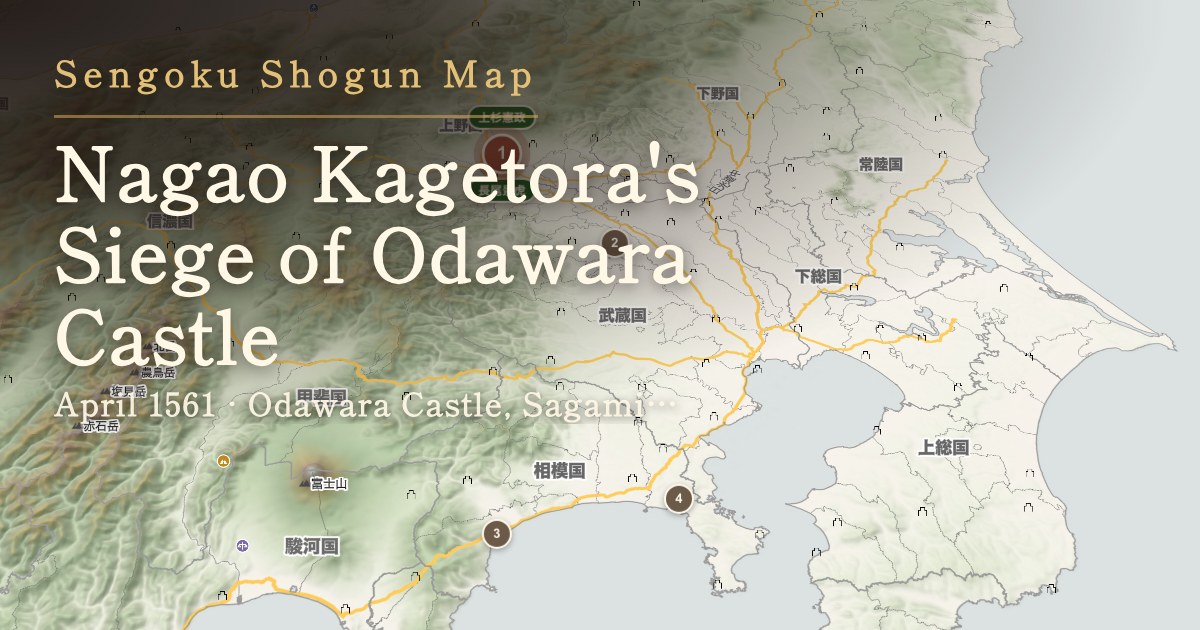
April 1561 · Odawara Castle, Sagami Province (now Odawara, Kanagawa)
Nagao Kagetora, at the head of the lords of the Kantō, besieged Odawara Castle without taking it, succeeded to the office of Kantō kanrei at Kamakura under the name Uesugi Masatora, and withdrew.
Background
Uesugi Norimasa, the Kantō kanrei driven out by the Later Hōjō, had turned to Nagao Kagetora of Echigo. Bearing Norimasa's cause, Kagetora crossed the mountains in the eighth month of the previous year, secured Numata, Iwashita and Maebashi in Kōzuke, and pushed south into Musashi.
Outcome
The castle held and the Uesugi army lifted the siege. Before the shrine of Tsurugaoka Hachimangū at Kamakura, Kagetora received the Uesugi name and the office of Kantō kanrei from Uesugi Norimasa, and took the name Uesugi Masatora.
Course of the battle
1 Autumn – winter 1560
Kagetora crosses the mountains and secures Kōzuke
2 Early spring 1561
The army moves south through Musashi as the Kantō lords gather
The Uesugi army moved south by way of Matsuyama Castle. Lords centered on Kōzuke and Musashi joined it, though their responses were not uniform — some, such as the Chiba of Shimōsa, remained on the Hōjō side.
Sources34·Certainty: Medium
3 April 1561
The siege of Odawara Castle
The Uesugi army invested Odawara Castle. The castle's own chronology records that in this year Kagetora attacked the lotus moat and set fire to the castle town. The castle did not fall.
Points of debate
The length of the siege and the number of troops engaged differ widely between sources; the Uesugi war tales give large figures.
Sources124·Certainty: High
4 Late April – May 1561
He succeeds to the office of Kantō kanrei at Tsurugaoka Hachimangū
Having lifted the siege, Kagetora moved to Kamakura. Before the shrine of Tsurugaoka Hachimangū he received the Uesugi name and the office of Kantō kanrei from Uesugi Norimasa and took the name Uesugi Masatora.
Sources15·Certainty: High
Historical significance
He gained the authority of the Kantō kanrei, but the campaign did not turn into real control: the Kantō lords who had joined him were not firmly united, and Odawara Castle's defenses and the length of his supply lines compounded the difficulty. From here the Uesugi crossings into the Kantō were repeated almost every year.
Key figures
上杉氏
4

Commander of the Uesugi army
Bearing the cause of Uesugi Norimasa he crossed the mountains and besieged Odawara Castle. During the campaign he took the name Uesugi Masatora; he is later known as Uesugi Kenshin.
Sources1·Certainty: High
The former Kantō kanrei
Driven out by the Later Hōjō, he had fled to Echigo; at Tsurugaoka Hachimangū he handed over his name and office.
Sources1·Certainty: High
Local lord of Musashi
One of the Kantō lords who joined the Uesugi army out of their own interest against the Hōjō.
Sources3·Certainty: Medium

Lord of Awa
A Bōsō lord who was at odds with the Later Hōjō; during this campaign he is said to have pressed the Hōjō from the Bōsō side in support of the Uesugi.
Sources3·Certainty: Medium
後北条氏
2

Head of the Later Hōjō
He held Odawara Castle and outlasted the campaign by using his network of branch castles and the length of the enemy's supply lines.
Sources1·Certainty: High
Fourth head of the Later Hōjō
With his father Ujiyasu he held Odawara Castle. The city of Odawara records this siege as an event of Ujimasa's time.
Sources1·Certainty: High
Other events of 1561
Notes on the data
Dates are given in the Western (Julian) calendar. The sources use the lunar calendar; the siege in the third month of Eiroku 4 falls in April 1561. The length and scale of the siege and the conduct of the troops in the castle town differ widely between sources, so no figures are given.
Sources consulted
- 小田原市「四代氏政の時代」
- 小田原城「歴史年表」
- Wikipedia「小田原城の戦い (1560年)」
- 城郭マスタ(shiro.geojson)
- 地理院地図 住所検索(神奈川県鎌倉市雪ノ下2-1-31)
The numbers in the text refer to the list above. Certainty indicates how far a statement is supported by the cited sources; it does not refer to the precision of the coordinates or the dating.
Advertisement