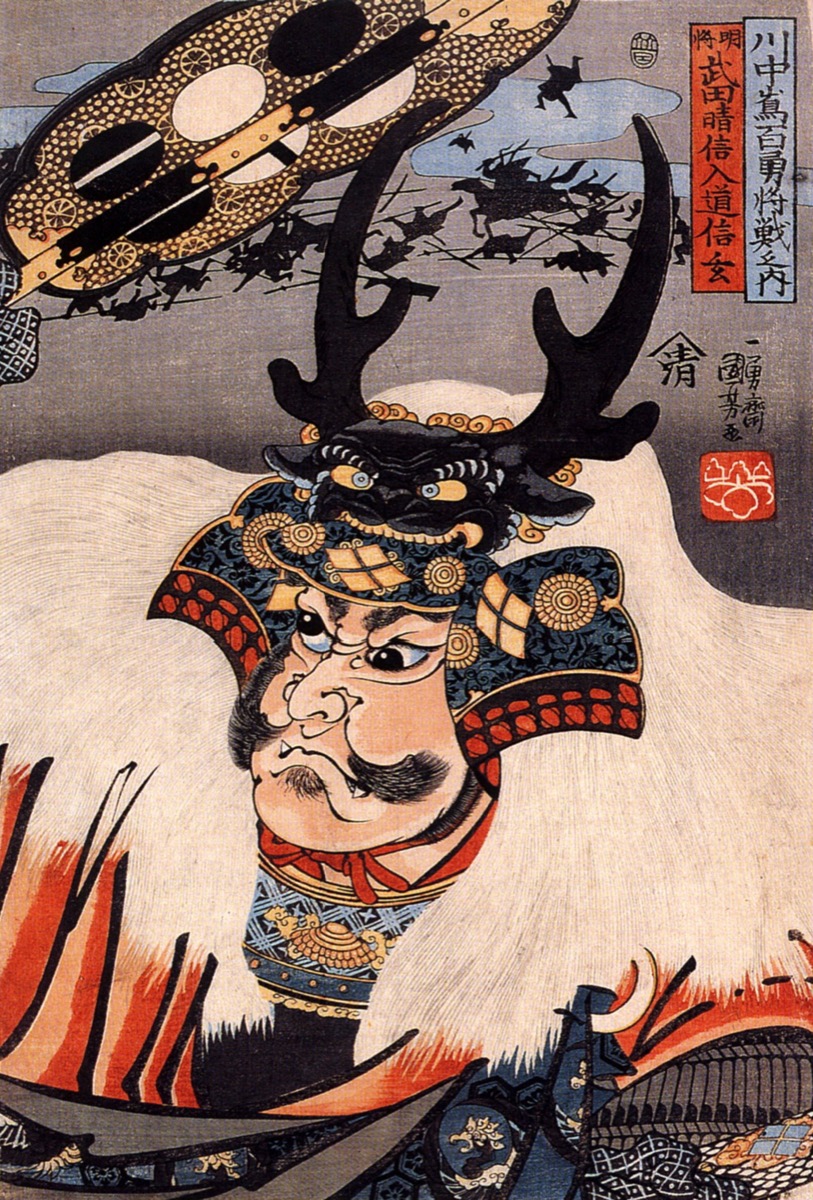
 歌川国芳「川中島百勇将戦之内 明将武田晴信入道信玄」
Head of the Takeda Clan of Kai
Takeda Shingen
武田信玄
1521 – 1573
After exiling his father Nobutora, he took over the Takeda clan and expanded into the Suwa, Saku, Chiisagata, and Shinano regions, facing Uesugi Kenshin in five confrontations at Kawanakajima. While stabilizing his borders through the Kai-Sagami-Suruga alliance and marriage diplomacy, the Yoshinobu incident led him to break with the Imagawa and invade Suruga. He governed his domain through the Kōshū Hatto legal code, land surveys, military levies, flood control (the Shingen embankments), and an economy built on gold mines and post roads, while building a military network of castles and beacon-fire signals. In 1572 he launched the westward campaign in response to the anti-Nobunaga coalition, defeating Tokugawa Ieyasu at Mikatagahara, but fell ill and died in camp the following year, 1573. His son Katsuyori succeeded him.
Sources 山梨県「ふるさと教材・年表」/浜松市博物館/浜松市「二俣城跡及び鳥羽山城跡」
Family tree
Takeda Shingen
This person
Ōbaiin
Child
Related events
19
1521
Month 11
Takeda Harunobu Is Born
Principal partyDuring an invasion of Kai by forces from Suruga, Lady Ōi took refuge at Yōgaiyama Castle and gave birth to Nobutora's heir Harunobu, later Shingen, on the third day of the eleventh month. His birthplace is traditionally identified as either the castle or Sekisuiji at its foot.
1541
Takeda Harunobu Succeeds to the Headship
Expelled his father Nobutora and became head of the TakedaTakeda Harunobu sent his father Nobutora into retirement in Suruga and succeeded to the Takeda headship and rule of Kai.
1542
Takeda Harunobu Conquers Suwa District
Led the conquest of SuwaTakeda Harunobu invaded Suwa District in Shinano, forced Suwa Yorishige to submit, and advanced his control of the region.
1544
Takeda Harunobu Attacks Fukuyo Castle
Commander in chief of the siege armyTakeda Harunobu advanced into Ina District and attacked Fukuyo Castle, defended by Fujisawa Yorichika and his allies, who resisted for more than fifty days.
1547
Kōshū Hattō Is Enacted
Enacted the provincial codeTakeda Harunobu enacted the Kōshū Hattō, a domain law code governing retainers and territorial administration.
1548
Battle of Uedahara
Takeda commander in chief; driven backTakeda Harunobu was defeated by Murakami Yoshikiyo at Uedahara and lost senior retainers including Itagaki Nobukata and Amari Torayasu.
1550
Battle of Toishi Castle
Commander in chief of the siege army; driven backTakeda Harunobu attacked Toishi Castle, held by Murakami Yoshikiyo's side, but failed to capture it and withdrew after suffering heavy losses.
1553
Month 7
First Battle of Kawanakajima
Takeda commander in chiefTakeda Harunobu and Nagao Kagetora confronted each other at Kawanakajima over control of northern Shinano.
1554
Kai-Sagami-Suruga Alliance Is Formed
Kai sideThe Takeda, Hōjō, and Imagawa established an alliance through marriages among their children.
1555
Month 8
Second Battle of Kawanakajima
Takeda commander in chiefTakeda Harunobu and Nagao Kagetora faced each other across the Sai River for a long time and came to terms through Imagawa Yoshimoto. No decisive battle was fought.
1557
Month 5
Third Battle of Kawanakajima
Takeda commander in chiefAfter the Takeda took Katsurayama Castle, Nagao Kagetora marched into northern Shinano, but the Takeda avoided a decisive engagement and nothing was settled.
1560
Month 6
Movements of Shinano Kokujin
Built up forces in the Kawanakajima areaTakeda Shingen strengthens forces near Kawanakajima, restraining Uesugi-aligned kokujin mobilization.
1561
Month 10
Fourth Battle of Kawanakajima
Took part / involvedTakeda Shingen and Uesugi Masatora met head-on at Hachimanbara and both sides suffered heavily. Nothing was decided, and the hold on northern Shinano did not change.
1571
Month 8
Close attention to forces in Hokuriku and the Eastern Provinces
Related figureThe actions of major daimyo such as Uesugi Kenshin and Takeda Shingen were seen as affecting the situation in Kinai. Both Nobunaga and Yoshiaki sought opportunities for broader alliances.
1572
Month 5
Takeda Shingen begins his western campaign
Overall command of the westward armyTakeda Shingen launched a full-scale advance toward Totomi and Mikawa, putting strong pressure on Tokugawa Ieyasu's territory and drawing attention as the coalition's most formidable military action.
Month 10
Takeda invasion of Totomi
Commanded the Totomi invasion forceTakeda Shingen advanced into Totomi and placed strong pressure on Tokugawa castles. Anxiety spread within the Tokugawa camp, and the balance in Tokai became sharply more tense.
Month 12
Battle for Futamata Castle
Takeda armyTakeda forces captured Futamata Castle in Totomi, breaking through part of the Tokugawa defensive line. Ieyasu was driven into a situation where he had to endure from Hamamatsu and wait for a chance to counterattack.
1573
1/25
Battle of Mikatagahara
Commanded the Takeda army; victoriousTakeda forces clashed with the Tokugawa-Oda allied army at Mikatagahara in Totomi, and Ieyasu suffered a devastating defeat. Takeda Shingen's military prestige was displayed to the whole country and gave the anti-Nobunaga side a major psychological boost.
Month 4
Death of Takeda Shingen
Died of illness during the westward campaignTakeda Shingen, who had been advancing on his western campaign, died of illness. With the loss of a figure capable of anchoring the anti-Nobunaga coalition, anti-Oda forces across the country lost much of their ability to coordinate.
Advertisement