INTERACTIVE BATTLE
Komaki and Nagakute Campaign
March to November 1584 · Komaki and Nagakute, Owari Province
Hashiba Hideyoshi fought Oda Nobukatsu and Tokugawa Ieyasu in Owari. While the armies sat facing each other at Komakiyama and Gakuden, a Hashiba column swung towards Mikawa and was destroyed at Nagakute. Ieyasu won the field; Hideyoshi won the settlement by making a separate peace with Nobukatsu.
Background
Having removed Shibata Katsuie at Shizugatake, Hideyoshi met resistance from Oda Nobukatsu, who claimed his father’s inheritance. Nobukatsu executed three senior retainers who had leaned towards Hideyoshi, bringing the quarrel into the open, and joined with Tokugawa Ieyasu.
Outcome
Ikeda Tsuneoki and Mori Nagayoshi fell at Nagakute and the Hashiba column was broken, but Hideyoshi widened the war into Ise and made a separate peace with Nobukatsu in November. Ieyasu, left without a cause, withdrew.
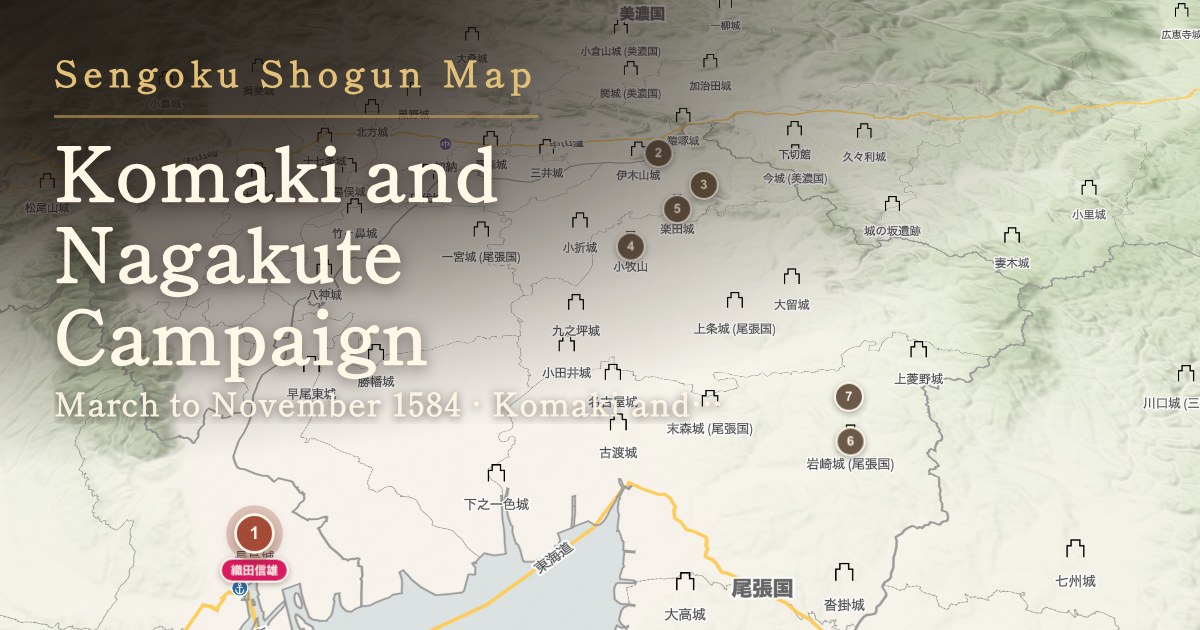
Course of the battle
1 17 March 1584
Oda Nobukatsu executes three senior retainers
At Nagashima castle Nobukatsu put three senior retainers to death for dealing with Hideyoshi. The break with Hideyoshi had gone past mending, and Nobukatsu turned to Tokugawa Ieyasu for help.
Executes three senior retainers at Nagashima castle
Sources1234·Certainty: High
2 March 1584
Ikeda Tsuneoki seizes Inuyama castle
3 28 March 1584
Mori Nagayoshi is beaten at Haguro
Sakai Tadatsugu and others waited at Haguro for Mori Nagayoshi’s force coming south from Inuyama castle and broke it. After losing the opening clash the Hashiba side held back from a frontal attack on Komakiyama, and the campaign settled into the standoff at Gakuden.
Sets his headquarters on Komakiyama
Sources12356·Certainty: Medium
4 March 1584
Ieyasu occupies Komakiyama
Ieyasu came into Owari in support of Nobukatsu and set his headquarters on Komakiyama, once Nobunaga’s own castle. He raised earthworks and settled in.
Sets his headquarters at Gakuden
Sources1234·Certainty: Medium
5 March 1584
Hideyoshi encamps at Gakuden and the standoff sets in
Hideyoshi placed his headquarters at Gakuden castle, and the two armies faced each other behind ditches and earthworks. Even with the numbers, the Hashiba had no way to break through from the front.
Sets out on the march into Mikawa
Sources1234·Certainty: Medium
6 April 1584
A Hashiba column swings towards Mikawa
To break the deadlock, Ikeda Tsuneoki, Mori Nagayoshi and Hashiba Hidetsugu set out to strike Ieyasu’s home province of Mikawa. Time spent attacking Iwasaki castle on the way had the effect of announcing the move to Ieyasu.
Points of debate
Who proposed the flanking march, and how far Hideyoshi knew of it, are read in different ways.
Falls on the flanking column from behind
Killed at Nagakute
Killed at Nagakute
Takes part in the battle of Nagakute
Takes part in the battle of Nagakute
Sources1234·Certainty: Disputed
7 April 1584
The Hashiba column is destroyed at Nagakute
8 November 1584
Hideyoshi makes peace with Nobukatsu
Hideyoshi widened the war into Ise, pressed Nobukatsu hard, and made peace with him without reference to Ieyasu. Left without a cause, Ieyasu withdrew. The side that had won the field gave way in the settlement.
Sources1234·Certainty: Medium
Historical significance
Ieyasu became one of the few lords to beat Hideyoshi in the field, yet Hideyoshi prevailed in policy. From the following year Ieyasu moved towards submission.
Key figures
羽柴氏
1

Commander-in-chief of the Hashiba
Held his headquarters at Gakuden through the standoff and ended the campaign by making a separate peace with Nobukatsu.
Sources9·Certainty: High
池田氏
1

Hashiba commander
Took Inuyama castle, joined the march into Mikawa, and was killed at Nagakute.
Sources9·Certainty: High
森氏
1

Hashiba commander
Beaten at Haguro and shot dead at Nagakute. Son-in-law of Ikeda Tsuneoki.
Sources9·Certainty: Medium
織田氏
1

Oda lord siding with the Tokugawa
Brought the quarrel into the open by executing his senior retainers, and in the end made a separate peace with Hideyoshi.
Sources9·Certainty: High
徳川氏
4

Commander-in-chief of the Tokugawa
Set his headquarters on Komakiyama and destroyed the Hashiba flanking column at Nagakute.
Sources9·Certainty: High

Tokugawa commander
Said to have beaten Mori Nagayoshi's force at Haguro.
Sources9·Certainty: Medium
Tokugawa commander
Took part in the battle of Nagakute.
Sources9·Certainty: Medium

Other events of 1584
Notes on the data
Dates are given in the Western calendar. The year 1584 falls after the Gregorian reform, but the sources use the lunar calendar and only one conversion could be fixed: the 6th day of the 3rd month of Tensho 12 equals 17 March 1584. Other phases are given to the month only.
Sources consulted
- 小牧市「小牧・長久手の合戦」
- 長久手市「長久手古戦場物語」
- 長久手市「小牧・長久手の戦い 石作神社」
- 城郭マスタ(shiro.geojson)
- 犬山市「犬山市文化財保存活用地域計画 第2章 文化財の概要」
- 愛知県「あいち歴史観光 羽黒城」
- 長久手市「史跡案内について」「古戦場公園再整備事業」
- 愛知県「あいち歴史観光 小牧・長久手の戦い」(国指定史跡 長久手古戦場)
- Wikipedia「小牧・長久手の戦い」
The numbers in the text refer to the list above. Certainty indicates how far a statement is supported by the cited sources; it does not refer to the precision of the coordinates or the dating.
Advertisement