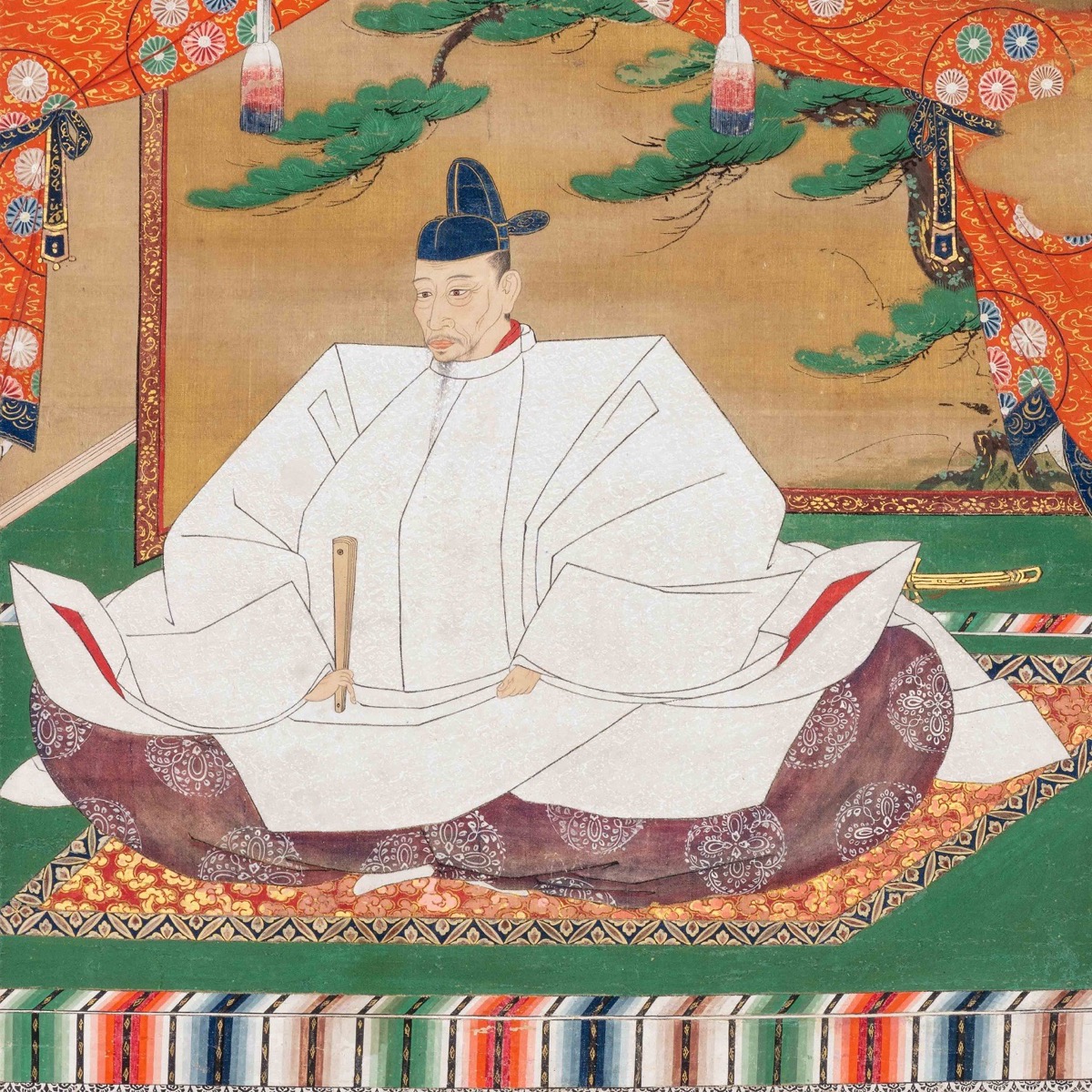
 狩野光信「豊臣秀吉像」
First Kampaku of the Toyotomi Regime
Toyotomi Hideyoshi
豊臣秀吉
1537 – 1598
As a retainer of Oda Nobunaga, he gained experience governing castle towns and directing logistics and sieges in Ōmi and the Chūgoku region, rising to prominence through the sieges of Miki, Tottori, and Takamatsu. After Nobunaga's death he made peace with the Mōri, defeated Akechi Mitsuhide at Yamazaki, and after defeating Shibata Katsuie at Shizugatake he built Osaka Castle as his base of power. As kampaku he pursued a policy of ending private warfare among daimyo, land surveys, and the sword hunt, and completed the unification of Japan by subduing Shikoku, Kyushu, and Odawara. In his later years his regime was destabilized by the purge of his nephew Hidetsugu and the invasions of Korea (the Bunroku and Keichō campaigns); he died in 1598, entrusting the future of his young son Hideyori to the Five Great Elders and Five Commissioners.
Sources 九州国立博物館メールマガジン/長崎県「年表で学ぼう」/熊本市「加藤清正」資料
Family tree
Related events
69
1537
Toyotomi Hideyoshi Is Born
BornToyotomi Hideyoshi, who would later complete the unification of Japan, is traditionally said to have been born in Nakamura, Aichi District, Owari Province; an alternative birth year of 1536 also exists.
1560
Month 5
Toyotomi Hideyoshi’s Grain Supply
Ran provisions into Odaka CastleKinoshita Tōkichirō (later Toyotomi Hideyoshi) successfully delivers provisions to Odaka Castle, earning Nobunaga’s trust.
1577
10/23
Hashiba Hideyoshi Marches into Harima
Took part / involvedOrdered by Oda Nobunaga to campaign against the Mōri in western Japan, Hashiba Hideyoshi marched into Harima and began the Chūgoku campaign in earnest.
12/3
Hashiba Hideyoshi Captures Kōzuki Castle
Oda commander in chiefAfter entering Harima, Hashiba Hideyoshi captured Kōzuki Castle, a stronghold linked to the Mōri side, and pushed the front of the Chūgoku campaign westward.
Hashiba Hidenaga Becomes Castellan of Takeda Castle
Related figureDuring Hashiba Hideyoshi's campaign in Tajima, his brother Hidenaga became castellan of Takeda Castle and assumed a key role in the Hashiba advance into western Japan.
1578
Month 3
Siege of Miki Begins
Took part / involvedBessho Nagaharu of Miki Castle broke with the Oda and aligned with the Mōri, prompting Hashiba Hideyoshi to begin the siege of Miki.
Month 7
Oda Nobutada Builds Forts Around Miki Castle
Took part / involvedOda Nobunaga's heir Nobutada joined the Miki campaign and strengthened the siege by constructing forts, including the hilltop fort at Hiraiyama that served as Hashiba Hideyoshi's headquarters.
1580
2/2
Miki Castle Falls
Oda commander in chiefAfter a siege lasting about twenty-two months, Bessho Nagaharu and his family took their own lives in exchange for sparing the garrison and townspeople, and Miki Castle surrendered to Hashiba Hideyoshi.
Hashiba Hideyoshi Makes Himeji Castle His Base
Commander in chief of the Chugoku campaignAfter pacifying Harima, Hashiba Hideyoshi received Himeji Castle from Kuroda Yoshitaka, rebuilt it, and made it the base for campaigns into Tajima, Inaba, and Bitchū.
1581
Month 5
Hideyoshi’s Inaba Campaign Begins
Commanded the Inaba invasion forceHideyoshi marches into Inaba, establishing bases to besiege Tottori Castle and gaining advantage in San’in.
Month 8
Expansion of War in San’in and San’yō
Commanded the Chugoku theater armyHideyoshi continues advances in Tajima and Inaba, escalating conflict with Mōri in western Honshu.
Month 10
Fall of Tottori Castle
Directed the starvation siegeThrough starvation tactics, Hideyoshi captures Tottori Castle, securing all of Inaba and depriving Mōri of a San’in base.
1582
Month 4
Siege of Bitchū Takamatsu Castle
Took part / involvedHashiba Hideyoshi besieged Bitchū Takamatsu Castle, defended for the Mōri by Shimizu Muneharu, and conducted a water siege.
Month 6
Oda Nobutaka Abandons the Shikoku Expedition and Joins the Yamazaki Campaign
Took part / involvedOda Nobutaka had assembled near Osaka for an expedition to Shikoku, but abandoned it after the Honnōji Incident. He then joined Hashiba Hideyoshi's army against Akechi Mitsuhide at Yamazaki.
6/23
Shimizu Muneharu's Death and the Surrender of Takamatsu Castle
Hashiba commander in chief who besieged Takamatsu CastleShimizu Muneharu took his own life, after which the Hashiba and Mōri sides concluded peace and Bitchū Takamatsu Castle surrendered.
6/25
The Chūgoku Great Return
Directed the Great Return from ChugokuAfter making peace with the Mōri, Hashiba Hideyoshi's army hurried from Bitchū through Himeji Castle toward the Kinai to confront Akechi Mitsuhide.
Month 7
Council at Kiyosu
Senior retainerAt Kiyosu Castle, Oda succession and territorial redistribution were discussed. Nobunaga's grandson Sanbōshi was chosen as heir over Oda Nobukatsu and Nobutaka, strengthening Hashiba Hideyoshi's influence.
7/2
Battle of Yamazaki
Hideyoshi's armyHashiba Hideyoshi defeated Akechi Mitsuhide near Yamazaki. Mitsuhide withdrew to Shōryūji Castle, escaped during the night, and died while attempting to reach Sakamoto Castle.
Month 10
信長の葬儀が大徳寺で営まれる
Hosted the funeral of Nobunaga羽柴秀吉が織田信長の葬儀を京都の大徳寺で営み、信長の子で秀吉の養子となっていた羽柴秀勝とともに主催した。清須会議後の主導権を示す場となった。
1583
6/11
Battle of Shizugatake
Took part / involvedThe armies of Hashiba Hideyoshi and Shibata Katsuie fought around Shizugatake in Ika District, Ōmi Province, and the Shibata army was defeated.
6/14
Fall of Kitanoshō Castle
Commander in chief of the force that attacked the ShibataAfter retreating from Shizugatake, Shibata Katsuie was attacked by Hashiba forces at Kitanoshō Castle and took his own life with Lady Oichi.
Month 9
Construction of Osaka Castle Begins
Led the castle constructionHashiba Hideyoshi began constructing Osaka Castle on the former site of Ishiyama Hongan-ji as a political and military base for unifying the realm.
1584
Month 3
Komaki-Nagakute Campaign Begins
Took part / involvedHashiba Hideyoshi's army and the allied forces of Tokugawa Ieyasu and Oda Nobukatsu confronted one another mainly in Owari Province, beginning a campaign that lasted about eight months.
Month 11
Peace between Oda Nobukatsu and Hashiba Hideyoshi
Made peace with NobukatsuOda Nobukatsu and Hashiba Hideyoshi made a separate peace while confronting one another near Nagashima. Tokugawa Ieyasu then withdrew, ending the Komaki-Nagakute campaign.
1585
Month 3
Kii Campaign
Took part / involvedThe armies of Hashiba Hideyoshi and Hidenaga attacked the Negoro and Saika groups and advanced their conquest of Kii Province.
Month 7
Hashiba Hideyoshi Becomes Kampaku
Became kampakuHashiba Hideyoshi was appointed kampaku, gaining an imperial office through which to advance his rule over the country.
1586
Month 2
Construction of Jurakudai Begins
Led the constructionToyotomi Hideyoshi began building Jurakudai in Kyoto as a government center and residence.
10/27
Tokugawa Ieyasu Meets Hideyoshi at Osaka Castle
Received Ieyasu's submissionTokugawa Ieyasu entered Osaka Castle and met Toyotomi Hideyoshi, entering the daimyō order under the Toyotomi government.
Toyotomi Hideyoshi Becomes Chancellor of the Realm
Principal partyToyotomi Hideyoshi was appointed daijō-daijin, the highest office of the imperial court.
1587
Month 3
Kyushu Campaign
Toyotomi Hideyoshi — 豊臣軍総指揮Toyotomi Hideyoshi invaded Kyushu after intervention in the Otomo-Shimazu conflict and compelled Shimazu Yoshihisa to submit.
Month 5
Shimazu Yoshihisa Submits to Hideyoshi
Received Shimazu Yoshihisa's surrenderFollowing the Toyotomi advance into Kyushu, Shimazu Yoshihisa submitted to Hideyoshi at Taiheiji in Sendai.
Month 9
Jurakudai Is Completed
Led the construction and made it a seat of governmentJurakudai was completed in Kyoto and became Toyotomi Hideyoshi's center for government and control of the daimyō.
10/1
Grand Kitano Tea Gathering
HostToyotomi Hideyoshi held a large tea gathering at Kitano Tenmangū that was open to participants regardless of social rank.
1588
Month 4
Imperial Visit to Jurakudai
Received the imperial visitEmperor Go-Yōzei visited Jurakudai, where Toyotomi Hideyoshi had the assembled daimyō pledge loyalty to the emperor and to himself.
Month 7
Sword Hunt Edict
Issuer of the orderToyotomi Hideyoshi issued the Sword Hunt Edict, ordering weapons such as swords, spears, and firearms to be taken from peasants.
1589
Month 10
Seizure of Nagurumi Castle
Ruled a breach of the Sobuji edictInomata Norinao, the Later Hōjō castellan of Numata, seized Nagurumi Castle, which Toyotomi Hideyoshi's settlement had assigned to the Sanada.
11/24
Hideyoshi Declares War on the Later Hōjō
Declared war and resolved on the Odawara campaignToyotomi Hideyoshi treated the seizure of Nagurumi Castle as a violation of his peace order and issued a declaration of war to Hōjō Ujinao.
Expansion of Yamanaka Castle
Rival against whom the extension was builtThe Later Hōjō strengthened Yamanaka Castle against an anticipated conflict with Toyotomi Hideyoshi, including the addition of the Daisaki outer enclosure.
1590
3/29
Battle of Yamanaka Castle
Toyotomi sideThe Toyotomi army attacked Yamanaka Castle, a Later Hōjō stronghold guarding the route to Odawara, and captured it within half a day.
4/3
Siege of Odawara Begins
Took part / involvedToyotomi Hideyoshi arrived at Odawara and his assembled armies began the siege of the Later Hōjō stronghold.
7/5
Hōjō Ujinao Surrenders
Accepted the surrender and closed the Odawara campaignHōjö Ujinao, who had held out in Odawara Castle, surrendered to Toyotomi Hideyoshi, ending the Odawara campaign.
Month 11
Kasai-Osaki Uprising
Toyotomi Hideyoshi — 奥羽仕置を主導Former retainers in the confiscated Kasai and Osaki territories rose against the newly installed Kimura house before being defeated at Sanuma Castle.
Ōshū Reorganization
Led the Oshu settlementToyotomi Hideyoshi entered Aizu and settled the territories of the northern daimyō. Date Masamune lost Aizu, which was granted to Gamō Ujisato.
1591
9/4
Kunohe Masazane Surrenders
The Toyotomi regimeSurrounded at Kunohe Castle by the Toyotomi government's northern army, Kunohe Masazane surrendered, ending major organized resistance in Ōshū.
10/10
Construction of Nagoya Castle Begins
Led the castle building and the Korean campaignConstruction began on Nagoya Castle in Hizen as Toyotomi Hideyoshi's base for the invasion of Korea, with daimyō from across Japan assigned to the works.
Month 12
Toyotomi Hidetsugu Becomes Kampaku
Passed the office of kampaku to HidetsuguToyotomi Hideyoshi transferred the office of kampaku to his nephew Hidetsugu, who took up government duties at Jurakudai.
1592
Month 3
Nagoya Castle Completed and Armies Assemble
Led the dispatch of troopsNagoya Castle, the domestic base for the invasion of Korea, was completed as daimyō armies from across Japan assembled in camps around it.
Month 3
Crossing to Korea Begins
Ordered the invasion of KoreaDaimyō armies ordered by Toyotomi Hideyoshi began departing from Nagoya for the Korean Peninsula, opening the Bunroku campaign.
Month 4
The Bunroku Campaign
総大将On Hideyoshi's orders 160,000 Japanese troops crossed to Busan, took Hanseong in twenty days and Pyongyang in two months. Yi Sun-sin's navy then cut the sea route, and righteous armies and Ming reinforcements pushed them back. In 1593 they withdrew from Hanseong to coastal forts in the south and opened talks.
Month 8
Construction Begins at Fushimi
Related figureAfter transferring the office of kampaku to Hidetsugu, Toyotomi Hideyoshi began building a retirement residence at Shigetsu Hill in Fushimi, the origin of Fushimi Castle.
1593
5/22
Hideyoshi Reports Peace Negotiations from Nagoya
Related figureWhile based at Nagoya, Toyotomi Hideyoshi wrote to Kita-no-Mandokoro reporting that Ming envoys had presented peace terms.
Month 8
Hideyoshi Moves to Fushimi
Related figureAfter Hideyori's birth, Toyotomi Hideyoshi moved to his Shigetsu residence in Fushimi and developed it into a full castle and new center of government.
8/3
Birth of Toyotomi Hideyori
Father; birth of the heirToyotomi Hideyoshi's son Hiroi, later known as Hideyori, was born at Osaka Castle, changing the political situation surrounding the Toyotomi succession.
1594
Month 1
Major Reconstruction of Fushimi Castle Begins
Related figureToyotomi Hideyoshi began transforming Fushimi Castle at Shigetsu into a full-scale fortress and political center intended to receive Ming envoys.
Month 8
Shigetsu Fushimi Castle Is Completed
Related figureShigetsu Fushimi Castle was completed and Toyotomi Hideyoshi entered it, making Fushimi a new center of government and transportation.
Development of Fushimi Port and the Taikō Embankment
Led the improvement worksAlongside the construction of Fushimi Castle, Fushimi Port was opened and major works including the Taikō Embankment improved river and land transport.
1595
Month 7
Toyotomi Hidetsugu Dies at Mount Kōya
Banished Hidetsugu to Mount KoyaAfter being stripped of the office of kampaku and exiled to Mount Kōya, Toyotomi Hidetsugu was ordered by Toyotomi Hideyoshi to take his own life.
7/28
Order to Demolish Jurakudai
Ordered the demolitionFollowing Toyotomi Hidetsugu's downfall, Toyotomi Hideyoshi ordered the demolition of Jurakudai, Hidetsugu's residence.
Month 8
Demolition of Jurakudai
Ordered the demolitionJurakudai was comprehensively dismantled, with some buildings and materials transferred to Fushimi Castle and other sites.
1596
Leap 7/13
Keichō Fushimi Earthquake
Lord of Shigetsu Fushimi CastleA major earthquake struck the Kinai region, destroying the recently completed Shigetsu Fushimi Castle and causing severe damage across Kyoto and Fushimi.
Leap 7/23
Rebuilding of Fushimi Castle Begins at Kohatayama
Related figureAbout ten days after Shigetsu Castle collapsed, Toyotomi Hideyoshi began building a new Fushimi Castle on Mount Kohata.
San Felipe Runs Aground in Tosa
Ruler who ordered the cargo seized and examinedThe Spanish ship San Felipe ran aground at Urado in Tosa. The seizure of its cargo and interrogation of its crew contributed to intensified persecution of Christians.
1597
2/5
Martyrdom of the Twenty-Six Saints of Japan
Ruler who ordered the executionTwenty-six missionaries and believers arrested in Kyoto, Osaka, and nearby areas were executed at Nishizaka in Nagasaki.
Month 7
The Keichō Campaign
総大将With the peace talks broken, the Japanese crossed again, crushed the Korean navy at Chilcheollyang and took Namwon, securing Jeolla. Halted at Jiksan and beaten at Myeongnyang by the reinstated Yi Sun-sin, they were pinned to their coastal forts. Hideyoshi's death in August 1598 brought withdrawal, and the seven-year war ended with the sea battle of Noryang in November.
Second Invasion of Korea Begins
Led the dispatch of troopsThe Toyotomi government ordered a renewed invasion of Korea, and daimyō armies again crossed from the domestic base at Nagoya in Hizen.
1598
3/15
Daigo Flower Viewing
HostToyotomi Hideyoshi held a grand cherry-blossom viewing at Daigoji with Hideyori, Kita-no-Mandokoro, Yodo-dono, and a large entourage.
8/18
Death of Toyotomi Hideyoshi
Died at Fushimi CastleToyotomi Hideyoshi died at Fushimi Castle, destabilizing the council system established to support the young Hideyori.
Withdrawal from Korea
Took part / involvedAfter Toyotomi Hideyoshi's death, the daimyō armies withdrew from Korea, ending the invasions launched from Nagoya in Hizen.
1599
Tokugawa Ieyasu Enters Fushimi Castle
The regime after his deathAfter Toyotomi Hideyoshi's death, senior regent Tokugawa Ieyasu entered Fushimi Castle and used it as a base for governing within the Toyotomi administration.
Advertisement