1582: The Honnoji Incident and the Beginning of the Struggle for Supremacy
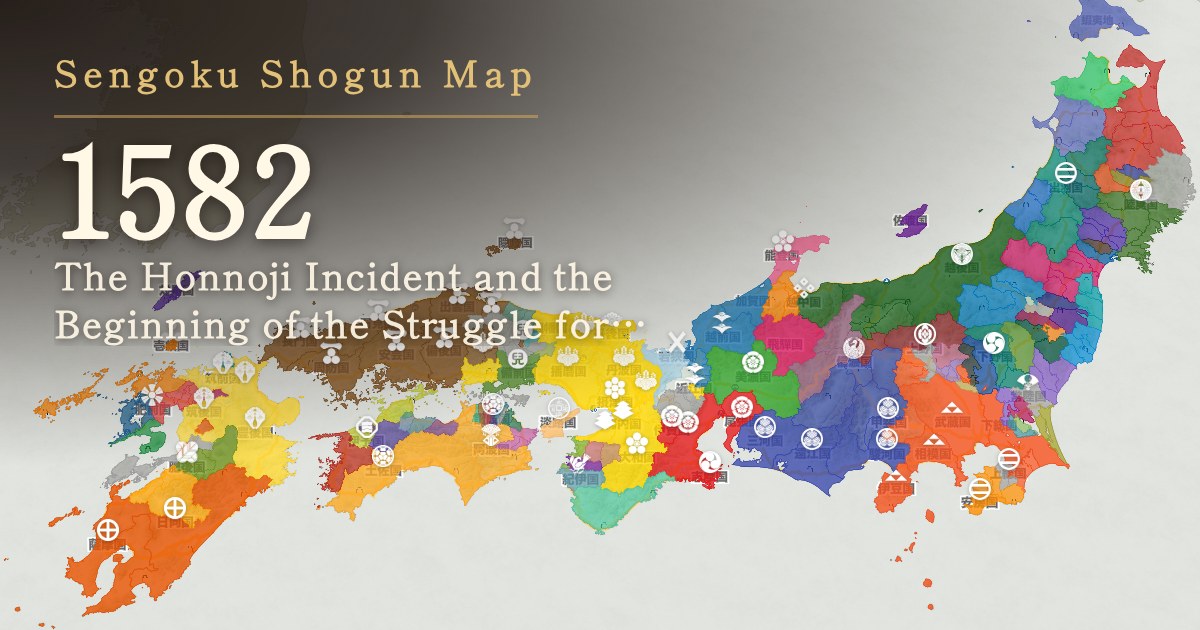
Nobunaga fell in the Honnoji Incident, and Hideyoshi won the Battle of Yamazaki after his rapid “Great Return” from the Chugoku front. The Takeda clan perished in the Koshu Campaign, expanding Oda authority, but succession struggles erupted after Nobunaga’s death.
Events this year
Month 3
After the fall of the Takeda, Oda Nobunaga granted Suruga Province to Tokugawa Ieyasu, making him lord of Suruga as well as Mikawa and Tōtōmi.
After the fall of Oyama Gobo, resistance continued in the Sannai district in the Hakusan foothills until Sakuma Morimasa crushed it, ending the roughly century-long Kaga Ikkō-ikki.
See this battle in detail →Sources 白山市「史跡鳥越城跡附二曲城跡」
3/25
Oda Nobutada's army captured Takatō Castle from Nishina Morinobu, prompting Takeda Katsuyori to abandon Shinpu Castle and retreat eastward.
Month 4
Hashiba Hideyoshi besieged Bitchū Takamatsu Castle, defended for the Mōri by Shimizu Muneharu, and conducted a water siege.
See this battle in detail →Sources 岡山県「備中高松城跡」/岡山市「高松城跡附水攻築堤跡」/岡山市「宇喜多氏と高松城水攻め~八幡山陣跡~」
4/3
Shibata Katsuie, Maeda Toshiie, Sassa Narimasa, and other Oda commanders surrounded Uozu Castle, a key Uesugi stronghold. The siege lasted about eighty days.
See this battle in detail →Sources 魚津市「魚津城と松倉城」/魚津市「魚津城の戦い」/魚津市「魚津の歴史と文化」
After abandoning Shinpu Castle, Takeda Katsuyori took his own life at Tano, bringing the Kai Takeda clan to an end.
Month 6
Oda Nobutaka had assembled near Osaka for an expedition to Shikoku, but abandoned it after the Honnōji Incident. He then joined Hashiba Hideyoshi's army against Akechi Mitsuhide at Yamazaki.
See this battle in detail →Sources Wikipedia「山崎の戦い」/Wikipedia「本能寺の変」
Hideyoshi pressed the Tottori Castle through supply line starvation and Takamatsu Castle through a dike-based water attack. After the Honnōji Incident, he concluded peace with the Mōri and withdrew.
See this battle in detail →6/21
After learning of the Honnōji Incident, Oda Nobutada moved from Myōkakuji to Nijō Palace and resisted the Akechi army, but took his own life when escape became impossible. The deaths of Nobunaga and his heir on the same day created an Oda succession crisis.
Akechi Mitsuhide assassinates Oda Nobunaga at Honnō-ji in Kyoto. Nobunaga dies.
See this battle in detail →Sources Wikipedia「本能寺の変」/Wikipedia「本能寺」
While touring the Kinai after visiting Azuchi, Tokugawa Ieyasu learned at Sakai of the deaths of Nobunaga and Nobutada and hurried to return to his domains with a small retinue.
See this battle in detail →Sources Wikipedia「本能寺の変」/Wikipedia「本能寺」
6/22
An Oda coalition led by Shibata Katsuie, Maeda Toshiie, and Sassa Narimasa captured Uozu Castle from the Uesugi side. The Oda forces withdrew after learning of the Honnō-ji Incident.
6/23
Shimizu Muneharu took his own life, after which the Hashiba and Mōri sides concluded peace and Bitchū Takamatsu Castle surrendered.
Assisted by people in Kōka and Iga and by the merchant Chaya Shirōjirō, Tokugawa Ieyasu escaped through Iga and reached Okazaki Castle on June 4.
6/25
After making peace with the Mōri, Hashiba Hideyoshi's army hurried from Bitchū through Himeji Castle toward the Kinai to confront Akechi Mitsuhide.
See this event in detail →Sources 大山崎町「秀吉の中国大返し」
Month 7
At Kiyosu Castle, Oda succession and territorial redistribution were discussed. Nobunaga's grandson Sanbōshi was chosen as heir over Oda Nobukatsu and Nobutaka, strengthening Hashiba Hideyoshi's influence.
See this event in detail →Sources 清須市「清須の人物伝」/江南市「織田信雄禁制」/愛知県公文書館「愛知の歴史資料」/清須市「清洲城」/あいち歴史観光「愛知ゆかりの武将・姫『織田家』」/滋賀県「賤ヶ岳の戦いから小牧・長久手の戦いへ」/文教大学教育学部・中村修也「清須会議の意味」/大阪大学学術情報庫「豊臣政権形成過程」
At the Kiyosu Council, Oda Nobutada's young son Sanbōshi, later Oda Hidenobu, was selected to succeed his grandfather Nobunaga. Claims centered on Nobunaga's sons Nobukatsu and Nobutaka were not adopted.
After the Kiyosu Council, Oda Nobutaka became lord of Gifu Castle and guardian of Sanbōshi. He kept the young heir at Gifu as he sought to strengthen his position within the Oda house.
After the Kiyosu Council, Oda Nobunaga's second son Nobukatsu received Owari and became lord of Kiyosu Castle. He subsequently expanded the castle and its town on a large scale.
As the former Takeda territories fell into disorder after the Honnōji Incident, Tokugawa Ieyasu entered Kai, confronted the Later Hōjō near Shinpu, and recruited former Takeda retainers.
7/2
Hashiba Hidenaga served in his brother Hideyoshi's army at the Battle of Yamazaki, a decisive step in Hideyoshi's rise after Akechi Mitsuhide's defeat.
See this battle in detail →Sources Wikipedia「山崎の戦い」/Wikipedia「本能寺の変」
Hashiba Hideyoshi defeated Akechi Mitsuhide near Yamazaki. Mitsuhide withdrew to Shōryūji Castle, escaped during the night, and died while attempting to reach Sakamoto Castle.
See this battle in detail →Sources Wikipedia「山崎の戦い」/Wikipedia「本能寺の変」
Month 10
The Tokugawa and Later Hōjō ended their confrontation over the former Takeda lands after mediation encouraged by Oda Nobukatsu and Nobutaka. Ieyasu secured Kai and southern Shinano, becoming lord of five provinces together with Mikawa, Tōtōmi, and Suruga.
A conflict between Tokugawa Ieyasu and the Later Hōjō over former Takeda territories was resolved by peace treaty. Ieyasu became a major daimyō by adding Kai and Shinano provinces to his domain, bringing his holdings to five provinces.
Sources 山梨県「遺跡トピックスNo.547」/富士宮市「戦国時代の富士宮 第7回」
羽柴秀吉が織田信長の葬儀を京都の大徳寺で営み、信長の子で秀吉の養子となっていた羽柴秀勝とともに主催した。清須会議後の主導権を示す場となった。
Sources 長浜市曳山博物館 特別展「秀吉と三人の秀勝たち」
After the Honnōji Incident created a power vacuum in the former Takeda territories, forces led by the Tokugawa and Later Hōjō fought across Kai, Shinano, and Kōzuke.